

Rachel Feltman: For Scientific American’s Science Quickly, I’m Rachel Feltman.
What comes to mind when you think about wildlife trade and diseases like COVID-19? If you live in the U.S., you probably picture so-called wet markets in Asia, where people buy and sell animal meat in an open-air setting, or perhaps foreign-sounding “bushmeat.” But in reality the wildlife trade is everywhere—including at your local suburban shopping center. And new research suggests that pathogens are spreading through this global trade network far faster than anyone realized.
Here to tell us more about these findings and their implications for the spread of zoonotic disease is Colin Carlson, an assistant professor of epidemiology at Yale University School of Public Health.
On supporting science journalism
If you're enjoying this article, consider supporting our award-winning journalism by subscribing. By purchasing a subscription you are helping to ensure the future of impactful stories about the discoveries and ideas shaping our world today.
Thanks so much for coming on to chat today.
Colin Carlson: Thanks for having me.
Feltman: To ask a very basic question, why is it that contact with animals leads to new diseases emerging?
Carlson: Pathogens have to have an opportunity to get to us, and that usually means proximity—we have to be close to another species. We are close to animals in our day-to-day life all the time, much more than we think we are, right? We have our pets in our house. Maybe we have that pigeon that, you know, sits on the window outside of our office. But we also have rats living in our buildings. We have bats roosting in our attics. I’m from Connecticut, so we had flying squirrels living in our attic when I was growing up. You know, who knows what viruses those guys have, right?
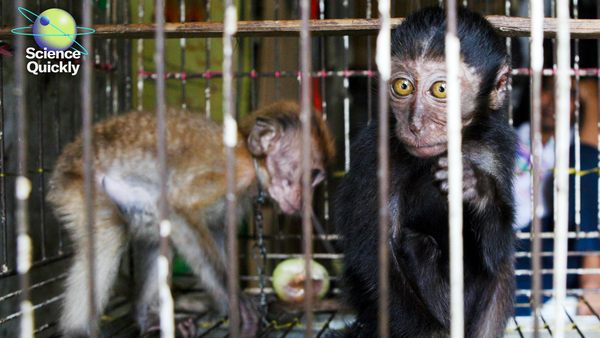
We are constantly in contact with wildlife, but most of the time it is very indirect and it’s very rare. Wildlife trade changes that equation. You are talking about people handling animals, butchering animals. You’re talking about moving animals thousands of miles sometimes, and that means that people are shipping them, they’re storing them in these dense conditions where the animals usually get pretty sick.
And in all of that what we’re also doing is we’re putting animals together in combinations that don’t necessarily exist in nature. And that means that viruses and other pathogens are spreading not just from animals to people but between animals, back and forth. We’re sort of turbocharging their evolution, right? We’re giving them all of these different opportunities to just bounce between hosts until they get something right. All of that makes it much easier for a pathogen to get into humans in the long run.
Feltman: So you recently published a study about the wildlife trade and zoonotic disease. Can you tell me a little bit about how you and your co-authors came to be curious about that question?
Carlson: Sure. We have been worried about the wildlife trade in public health for a long time. COVID comes to mind, obviously, with sort of this question of “Where did SARS-CoV-2 come from?,” but we’ve been thinking about the wildlife trade for much longer than that. You know, SARS started in the wildlife trade. We had an outbreak of mpox in the United States back in 2003. And of course, HIV probably started with rural hunting communities in Africa.
And so there’s always been this understanding that wildlife trade is probably a risk to human health. But what’s been really hard is we don’t know how to quantify that, right? We have a lot of anecdotal evidence. We have these individual outbreaks that matter a lot to us. But we haven’t had a big picture look at what is the cumulative impact on our health? So that’s sort of the jumping-off point for this.
Feltman: And where did you go looking for that data?
Carlson: So we’re doing a, a very, like, global look here, right? So we’re saying, “Okay, here’s every species that we know exists in the wildlife trade, and here’s every virus that we know those species have.” And we’re putting those data together, and we’re saying, “What does that tell us about how viruses are moving around?”
Those data are incredibly hard to get on both sides, it turns out. We don’t know a lot about the wildlife trade, and we know even less about what viruses most animals have. So it’s taken a long time to get enough data to ask a question like this. But we’re finally at this point where we know enough about some of these species that we can say, “Okay, here are the viruses that are in animals, and then as they spend time in the wildlife trade, here are the viruses that are making the jump to humans.” And that’s the red flag we’re looking for.
Feltman: Yeah. Well, one thing that I thought was interesting, the fact that I think it was something like a quarter of [terrestrial] vertebrates are traded in some way. And I think, you know, most of our listeners, you know, will probably hear what this study is about and think, like, “Oh, yeah, bats.” But can you tell me a little bit more about just how broad this issue is? You know, what kinds of animals are we talking about, what kinds of diseases?
Carlson: Wildlife trade is everywhere, right? I think we have this idea in our head of sort of this wet market with exotic animals, and it, it feels very, you know, foreign to us. But anytime you go to PetSmart and there are geckos there, there are tetras that come from the Amazon rainforest, right, all of those species are—that’s wildlife trade.
We do wildlife trade in our day-to-day lives. If you’ve ever worked at a PetSmart, if you have watched the Joe Exotic documentary, right, all of those tigers, that’s wildlife trade. And, you know, maybe we don’t all have tigers, but, you know, I guess more of us do than we thought, right?
But I think that idea that, like, a quarter of [mammal] species are in the wildlife trade—humans just interact with wildlife constantly, right? We eat them. We turn them into products. We keep them as pets. There are so many different ways that we are interacting with animals, and there’s sort of no limit to how many species get pulled.
Feltman: Yeah, so what other misconceptions do you think the public has about the relationship between wildlife trade and disease?
Carlson: I think that there is this common idea that all we have to do is just ban the wildlife trade, right, that this is a simple problem that exists somewhere else, when in reality it’s a here problem and it’s an everyone problem and it’s probably not going away.
One of the things that I think a lot of people don’t know about wildlife trade is at the international scale, it actually looks a lot like climate change or deforestation, where a lot of the impact is falling on biodiversity in tropical countries, in lower-resource communities, but it’s driven by economic demand from the U.S. and Europe and China.
And that means that, first of all, we have a role to play in reducing demand, right? It’s not just an other-people problem. It’s an us problem. It’s an everyone problem. But it also means that we are probably not able to just ban wildlife trade, right? What happens when we do that is we push trade underground, and this has been seen again and again over the last few decades. Every time we get really worried about wildlife trade, we go and we scramble and we try to shut it down, and it just doesn’t work.
Feltman: Can you give me a sense of the scope of the data that you guys were working with?
Carlson: Sure. So what’s really special about this study is that we have more data than we’ve ever had on animal pathogens, so not just viruses but also bacteria, fungi, parasites—there are worms that come from animals to humans. And we have more data than we’ve ever had in one place on wildlife trade, so we’re looking over about 40 years of trade.
The wildlife trade has changed dramatically in that time. If you think about 100 years ago, we’re talking about rural communities living off of wild-animal hunting, but wildlife trade has become not just international but industrialized, right? We have wildlife farms at a scale that we’ve never had, and that’s mink farms in the U.S. and it’s fur farms in China, right? All of that is a relatively recent thing on the timescale of humans sharing viruses with animals.
Feltman: Mm. So let’s get into your results. What did you actually find when you looked at this data?
Carlson: It turns out that diseases are spreading in the wildlife trade much faster than we thought. Wildlife trade is this incredibly intense process. Diseases are moving very quickly. And so what we found is that just being in the wildlife trade makes it about 50 percent more likely that an animal hosts a pathogen that poses some risk to human health.
Feltman: Wow.
Carlson: You know, again, wildlife trade is sort of ubiquitous within mammals, right? So it’s actually quite striking we get that strong a result.
And then the part of the study that I just think is so cool—there’s always a possibility, right, that this is just correlation. So if you think about some of the species we trade a lot, there are a lot of primates in the wildlife trade. We also share a lot of pathogens with primates not because of the wildlife trade but just because their immune systems look like ours. It’s very easy for diseases to move back and forth. That’s not necessarily causal, right? So how do we disentangle those things?
Well, the trick here is, for most of these species, we know how long they’ve been in the wildlife trade, and that gives us the smoking gun. So for every 10 years that a species is traded, on average, about one more pathogen makes the jump. Think about that versus, like, 10,000 years of livestock disease, right? It’s so fast, and we wouldn’t see that pattern if there weren’t something dramatically different happening in the wildlife trade than in any other setting, really.
Feltman: So do you have any thoughts on what we should be doing about this?
Carlson: Wildlife trade is a hard problem to solve. I’ve worked on it for a long time, and I have for a long time been one of the sort of dissenting voices on, you know, we shouldn’t just be rushing to ban everything, and that’s because I don’t wanna see trade get driven underground. One thing that we find in this study is that black markets actually probably make all of these problems even worse. So species that are illegally traded are actually sharing even more pathogens with us. Criminalizing doesn’t seem to work.
There’s also, like, human rights issues here, right? We can’t just solve everything with criminalization, and among other things, you know, think about if we know that the next pandemic is gonna start with someone who handles wildlife, someone who works in a market or works in a supply chain, when that person gets sick we need them to be able to go to the doctor without being afraid that they’re gonna go to jail.
So we can’t just ban the wildlife trade. There are a couple things that we can do, though. One is we can try to reduce demand, particularly in the U.S. A lot of wildlife trade is our fault. Next time you’re at Petco, think about whether you really need that gecko.
Another thing that we can do is we can invest in alternative careers in communities that rely on, particularly, things like wildlife farms that we really don’t need. I think it’s gonna be very hard to shift people off of wild animal protein, and there’s actually studies that show that the task of doing that would actually lead to so much more agriculture in some places that it would actually be worse for biodiversity.
So, you know, some people are always gonna be living off of wild animal protein, and that’s not just in faraway places. There are certain industries, especially fur farming, that we just really don’t need, and I think it is very reasonable to think about eliminating them.
The last piece of this, though—and, and to me what the public health answer is—you know, there’s always gonna be some wildlife trade, and like with climate change or biodiversity loss it’s gonna take us decades to solve this. We can’t wait to solve wildlife trade to be ready for the next pandemic.
So what that means is we need to start looking for viruses in markets, on farms, in the people who work in these settings. We have really poor disease surveillance in most wildlife-trade communities, and statistically, the next person to get a SARS-like virus is probably gonna be one of those workers, right? And we wanna be able to, day one, when we see that first case of SARS-CoV-3, we wanna be there, we wanna be ready to quarantine people. And we have to be able to do that transparently and with trust with communities. And all of that is just—it’s a huge state shift in how we think about these problems, but I think public health has to tackle it, or we’re just gonna keep having more COVIDs.
Feltman: As somebody who’s working in this field and looking at this data, what are some things we need to be doing to prepare for the next pandemic?
Carlson: We need a lot more basic science about viruses and animals and the connections between them. There are a lot of just foundational things we take for granted about how ecosystems are changing or how people are affecting disease patterns in nature, and we just don’t know for sure.
We don’t know how many people die from climate change every year. We don’t know where wildlife trade is actually accelerating the fastest. There are things we can measure from space, so maybe we have a sense of where deforestation is happening, but for the most part we don’t have eyes and ears in most of the places where the next pandemic will start or the next planetary crisis is happening.
So I think just we need so much more basic investment in science and in data collection, right? There’s a lot that we can do with the data that’s already out there, but we need a lot more data before we can actually start to tackle some of these problems.
I think that this project is a really great poster child for basic science, all the boots-on-the-ground tracking of wildlife trade. But five years ago we wouldn’t have been able to do this study because we didn’t have a list of “Here are all of the animals, and here are all of the viruses they have.” You know, five years ago we couldn’t ask that question with the data we had, and five years from now we might not be able to because those data might not be supported anymore. So, you know, a general plea here of we’re doing what we can, but I hope that this is a wake-up call that we have to keep investing in this kind of work.
Feltman: Well, Colin, thanks so much for coming on to talk to us about this study. I really appreciate it.
Carlson: Thank you.
Feltman: That’s all for this week on Science Quickly. We’ll be back on Monday with our usual science news roundup.
Science Quickly is produced by me, Rachel Feltman, along with Fonda Mwangi, Sushmita Pathak and Jeff DelViscio. This episode was edited by Alex Sugiura. Shayna Posses and Aaron Shattuck fact-check our show. Our theme music was composed by Dominic Smith. Subscribe to Scientific American for more up-to-date and in-depth science news.
For Scientific American, this is Rachel Feltman. Have a great weekend!
