
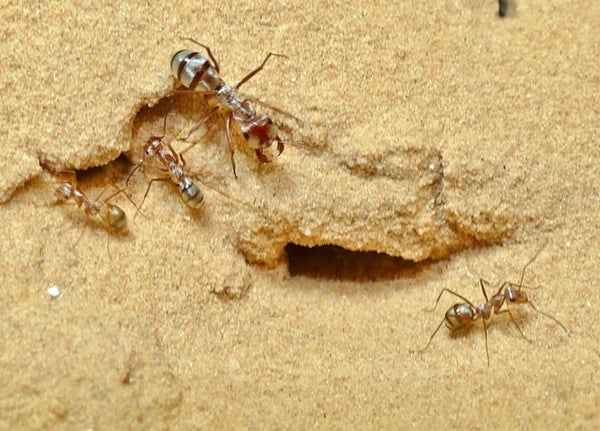

The Sahara Desert, where daytime temperatures can reach 140 degrees Fahrenheit. Not many organisms can survive in this harsh environment. But an insect called the Saharan silver ant thrives. They scurry out onto the sand from their protected nests to gather up the carcasses of less fortunate insects that have died from the heat.
“The hotter the day, the more insect bodies they will find. The more food they have.”
Sarah Pfeffer, an animal behaviorist at Ulm University in Germany. She says that to avoid sinking into the Saharan sand dunes, where they could meet the same fate as their lunch, silver ants have to be fast.
On supporting science journalism
If you're enjoying this article, consider supporting our award-winning journalism by subscribing. By purchasing a subscription you are helping to ensure the future of impactful stories about the discoveries and ideas shaping our world today.
To document just how quickly the ants move, Pfeffer and her colleagues set up high-speed cameras above a channel between the entrance to the hungry ants’ nest and a food source. The researchers recorded top speeds approaching 35 inches per second.
“But if you really look how big the animals are, and you calculate the body length per second, you come up with a walking speed that is an astonishing 108 body lengths per second.”
That figure makes them the fastest known ant on the planet. By comparison, cheetahs top out at about 16 body lengths per second.
The videos revealed how the ants achieve such prodigious speeds. As they accelerate, their leg movements become synchronized. They increase their stride length by bringing all six feet off of the sand at once, which Pfeffer describes as a gallop.
“Really, all legs are lifted from the ground. They are in air, but it’s not jumping. It’s a very smooth run that they have.”
Pfeffer says they’re thus faster than a closely related ant species called Cataglyphis fortis, which has longer legs but a less impressive airborne phase. That ant only reaches about 24 inches per second, or two thirds of the silver ant’s max.
The study appears in the Journal of Experimental Biology. [Sarah Elisabeth Pfeffer et al., High-speed locomotion in the Saharan silver ant, Cataglyphis bombycina]
The Saharan silver ants’ breakneck speeds may be impressive, but two insects are even faster: the California coastal mite and the Australian tiger beetle, both of which also thrive at near-lethal temperatures. Seems that to beat the heat, it pays to be fleet.
—Susanne Bard
[The above text is a transcript of this podcast.]
