
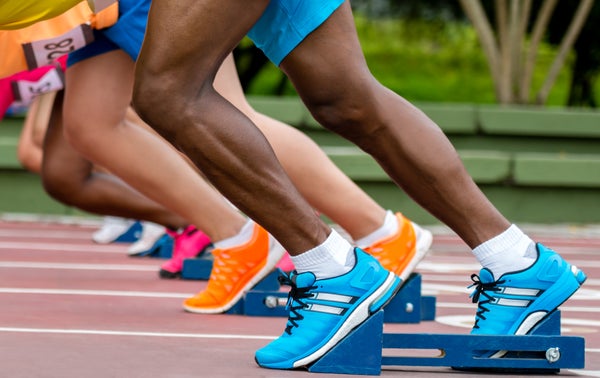

Homo sapiens are nowhere near the fastest runners in the animal kingdom. But what we lack in speed, we make up for in endurance. And we're specially equipped to go the distance. We've got bigger butt muscles than other primates. We lost most of our fur, too, and sprouted lots of sweat glands, to help us cool off.
Scientists believe our endurance running abilities began to appear two [million] to three million years ago, around the time the genus homo came about. And a new study suggests that a mutation in one key gene had something to do with it.
The mutation, in what's called the CMAH gene, altered the types of sugar molecules that decorate the surfaces of every cell in our bodies. Which in turn may have made our muscles less prone to fatigue.
On supporting science journalism
If you're enjoying this article, consider supporting our award-winning journalism by subscribing. By purchasing a subscription you are helping to ensure the future of impactful stories about the discoveries and ideas shaping our world today.
Researchers have now found that mice bred with that same mutation can run longer without tiring, compared to regular mice. The mice with the gene alteration also logged more miles running on their wheels, apparently for fun. And they had more capillaries in their back leg muscles—which would increase the delivery of nutrients and oxygen during endurance exercise.
The complete stats are in the Proceedings of the Royal Society B. [Jonathan Okerblom et al., Human-like Cmah inactivation in mice increases running endurance and decreases muscle fatigability: implications for human evolution]
It's unclear if this small genetic tweak endows humans with the same benefits as the mice. But if it does, it could help explain how early humans got a leg up on their competitors. Or, really, two legs.
—Christopher Intagliata
[The above text is a transcript of this podcast.]
