
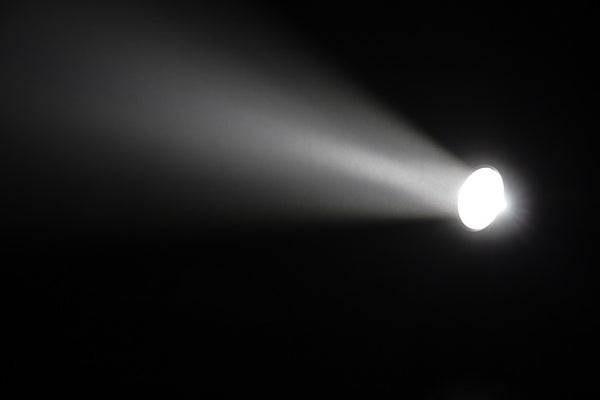

LEDs use only a quarter the energy of incandescent bulbs. But despite their efficiency, there is one thing they're not that good at: "They have a hard time giving directional light." Sangam Chatterjee, a physicist at the University of Marburg and the University of Giessen, in Germany.
Chatterjee and his colleagues may have fixed that. They devised a highly focused, but still energy-efficient light beam, by starting with something that's already a highly focused beam: a laser. The key is what they shoot the laser at: a substance with a particular structure. "I'm always tempted to say "white powdery substance" but I guess there's some connotation on that."
They synthesized the material from cages of tin and sulfur atoms decorated with hydrocarbon molecules. The laser-produced infrared light—which the human eye cannot see—goes in, but what comes out are many different optical wavelengths. "It's a molecular light converter. It basically changes the color of the light, while retaining the directionality of the lasers. So you can make something like a white laser beam containing many, many colors." That mix of colors, overall, glows bright white, like a halogen bulb in a beam. The study is in the journal Science. [Nils W. Rosemann et al., A highly efficient directional molecular white-light emitter driven by a continuous-wave laser diode]
On supporting science journalism
If you're enjoying this article, consider supporting our award-winning journalism by subscribing. By purchasing a subscription you are helping to ensure the future of impactful stories about the discoveries and ideas shaping our world today.
This sort of low-energy focused white beam could be used for the very small—like a light source for microscopes—to the very big. "You could use this for a spotlight in the theater. And in the end it should be much more energy efficient than the typical standard spotlight that you have." Meaning focused white light…that takes a little heat off the environment.
—Christopher Intagliata
[The above text is a transcript of this podcast.]
