

Mosquitoes are precision guided to their prey by plumes of carbon dioxide, heat and humidity. Sort of like how we follow our noses sometimes.
“It’s like us passing a restaurant: we might look at the signs and the display case and the smell. It’s a lot of things they do. They’re very smart, unfortunately.”
Robert Hurt, a chemical engineer Brown University. As the skeeters get closer to us, he says, they also even smell and taste.
On supporting science journalism
If you're enjoying this article, consider supporting our award-winning journalism by subscribing. By purchasing a subscription you are helping to ensure the future of impactful stories about the discoveries and ideas shaping our world today.
“They have gustatory receptors. They taste chemicals associated with your sweat. You have bacteria on your skin, the bacteria metabolize compounds in your sweat and the mosquitoes detect those.”
You know what happens next. The bite. But Hurt and his colleagues have discovered a novel way to block them: with graphene, the substance composed of a single layer of carbon atoms.
Hurt and his team asked volunteers to stick their arms into a box full of mosquitoes. “We don’t actually disclose who those research subjects were, but we were closely involved.” In other words, he will neither confirm nor deny that he and his colleagues were subjects.
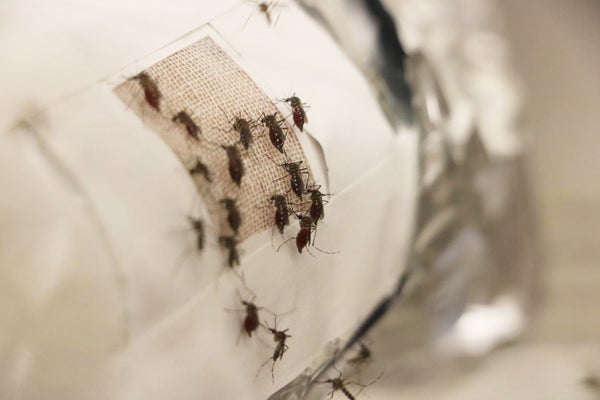
So whoever the subjects were, when they had no skin protection, the mosquitoes swarmed and bit the skin. However, with a graphene-based patch on the skin, the mosquitoes landed but seemed uninterested—and largely didn’t bite. Hurt thinks that’s because the film blocks those chemical cues the mosquitoes kind of “taste” on the skin. And when the film was dry, at least, it also physically blocked the mosquitoes from plunging their tiny hypodermic needles into the prospective victim.
The results are in the Proceedings of the National Academy of Sciences [USA]. [Cintia J. Castilho et al., Mosquito bite prevention through graphene barrier layers]
Mosquitoes could still sense the CO2 in your breath, of course. But when they get there, if you're wearing graphene, there wouldn’t be much to bite. And Hurt says the graphene film is cheap—just a few cents per square foot—and breathable. So if they can figure out how to keep the material mosquito-proof when moist, they’ll be one step closer to graphene-laced antimosquito clothing.
So has Bill Gates called yet to see if this research could lead to another weapon against malaria? “He hasn’t, you know. But he calls all the time anyway, so I’m always trying to put him off. But if he does, I’ll talk to him, yeah.”
—Christopher Intagliata
[The above text is a transcript of this podcast.]
