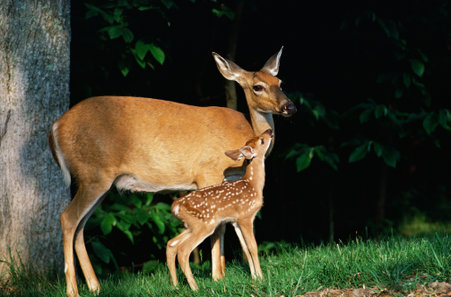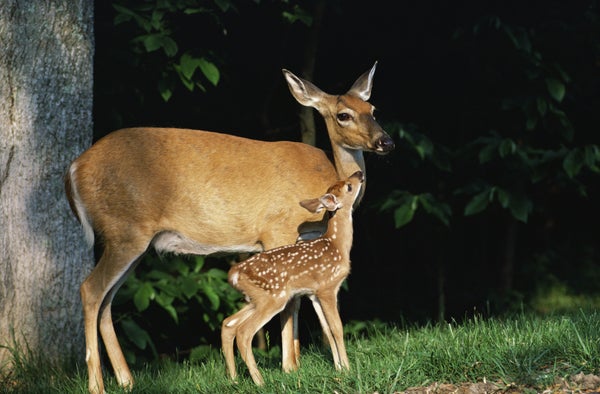

Thirty million white-tailed deer now live in North America. "That's a lotta deer." Megan Gall, a sensory ecologist at Vassar College in Poughkeepsie, New York. In her Hudson Valley locale, "there was a recent estimate here that you could have 20 to 40 deer per square mile."
These prolific grazers have been blamed for many things: munching on baby trees "and that's a big problem because they are going to prevent forest regeneration." They also change the structure of the forest understory, "which is no good for birds that live there, small rodents that live there." And they contribute to the lyme disease problem as tick hosts.
To all that, we can now add a new accusation: that deer are altering the very acoustics of the forest, by pruning trees and changing the way sounds—like bird calls—travel through the trees.
On supporting science journalism
If you're enjoying this article, consider supporting our award-winning journalism by subscribing. By purchasing a subscription you are helping to ensure the future of impactful stories about the discoveries and ideas shaping our world today.
Gall and her team investigated plots of forest where deer graze, and others where they were excluded. In each thirty-by-thirty-foot plot, they placed a speaker at one end, playing white noise <>, tones <> or trills <>. And recorded it all with a microphone in the opposite corner.
Then, they used software to analyze the recorded sounds. They found that while there was no difference in the loudness of the captured sounds among plots, the recordings captured in the grazed-upon plots did have higher sound fidelity—meaning they were closer in quality to the original playback tracks.
On the face of it, that might sound like a good thing. But as Gall explains: "If your sound has better fidelity, it's going to be picked up by more individuals. If you're a territorial animal you might get into more fights. If you're worried about predators, predators might have an easier time hearing you. And so higher fidelity isn't always better." The results are in the journal PLOS ONE. [Timothy J. Boycott, Jingyi Gao, Megan D. Gall: Deer browsing alters sound propagation in temperate deciduous forests]
And to be clear, the researchers aren't arguing for any specific intervention. "I mean the deer situation is a minefield and I don't know how much I want to weigh in on it." But the findings might give advocates for increased deer management a bit more ammunition.
—Christopher Intagliata
[The above text is a transcript of this podcast.]