
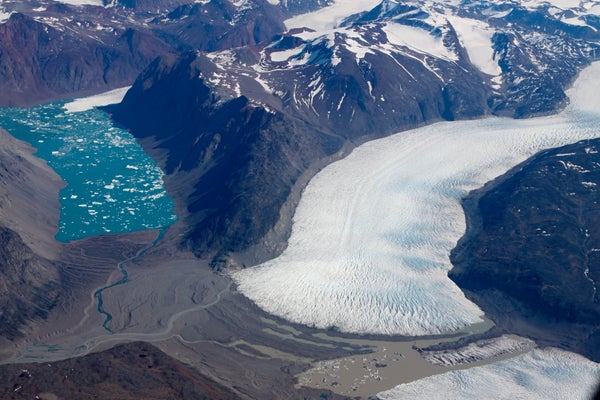

The massive ice sheet topping Greenland is losing nearly 300 billion tons a year to melting, according to NASA estimates. And all that meltwater means rising seas. But it's also dumping huge amounts of nutrients and minerals into Arctic waters.
"The great thing about glaciers and ice sheets, is that they're these big, very heavy systems, and as they move over rock they grind and crush the rock up." Jon Hawkings, a glacial biogeochemist at the University of Bristol in the U.K. "So they expose all these reactive kind of trace components of the rock lattice to the fresh meltwater that's coming in.”
That meltwater funnels rock dust into Greenland's glacial rivers, where Hawkings and his colleagues took their samples. They found that Greenland's rivers are much richer in phosphorus than previously believed. And they estimate that Greenland's glacial rivers may flush some 400,000 tons of phosphorus into ocean waters every year—that’s on par with the amount of phosphorous dumped into the ocean by the Mississippi or Amazon rivers. The findings appear in the journal Global Biogeochemical Cycles. [Jon Hawkings et al, The Greenland Ice Sheet as a hot spot of phosphorus weathering and export in the Arctic]
On supporting science journalism
If you're enjoying this article, consider supporting our award-winning journalism by subscribing. By purchasing a subscription you are helping to ensure the future of impactful stories about the discoveries and ideas shaping our world today.
All that extra phosphorus could be fertilizer for ocean life. "It's an essential nutrient for phytoplankton, who are the guys on the bottom of the food chain. So it's really, really important for life. And life can't exist without it." And this process—glaciers grinding rocks, then melting and flushing those nutrients to sea—it’s not the first time it's happened. In fact, the authors speculate that during the last extreme ice age—the so-called "snowball Earth," some 700 million years ago—all this phosphorus runoff may have caused a bloom in ocean life. A bloom that may have ultimately oxygenated the planet...and paved the way for organisms like us.
—Christopher Intagliata
[The above text is a transcript of this podcast.]
