

If you’ve ever been on a fishing boat, you’ve probably seen flocks of birds following in your wake, hoping to catch a snack. Now scientists say they can use those birds’ behavior to track illegal fishing boats.
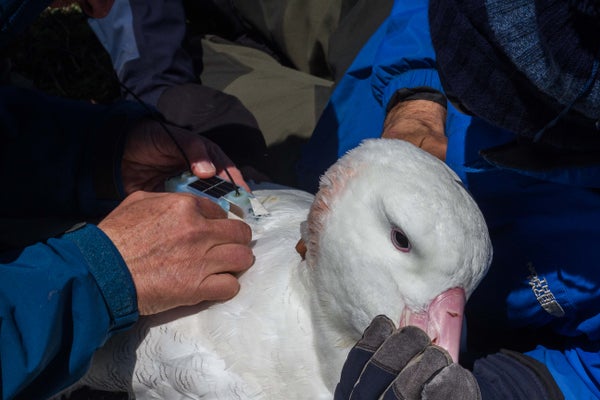
Here’s how it works: Researchers attached data loggers to the backs of 169 albatrosses in the Southern and Indian oceans. The devices weighed only an ounce and a half, but they included a GPS—which enabled them to detect the presence and intensity of radar signals emanating from boats. That information was then transmitted by satellite, so the researchers could track the location of the birds—and thus the radar-emitting boats—in real time.
The scientists then cross-checked that data against the known locations of boats, gleaned from a system boats use to declare themselves, called the Automatic Identification System. And discrepancies appeared frequently.
On supporting science journalism
If you're enjoying this article, consider supporting our award-winning journalism by subscribing. By purchasing a subscription you are helping to ensure the future of impactful stories about the discoveries and ideas shaping our world today.
More than a third of the times the birds’ loggers’ detected radar signals, and therefore a boat, no such boat appeared in the official log—meaning that the vehicles had likely switched off their Automatic Identification Systems—something the researchers say probably happens in illegal fishing operations.
The results are in the Proceedings of the National Academy of Sciences. [Henri Weimerskirch et al., Ocean sentinel albatrosses locate illegal vessels and provide the first estimate of the extent of nondeclared fishing]
The work suggests birds could be an effective boat-monitoring tool—as long as illegal fishing operations don’t target the birds, that is. Fortunately, such a task would be difficult.
“Around fishing vessels, you can get hundreds of birds at any one time that are all flying around. So it’s not really possible to target a specific bird. And the birds with loggers on are not marked in any way. So it’s difficult for fishermen to pick out a specific bird.”
Study author Samantha Patrick, a marine biologist at the University of Liverpool.
Patrick’s bigger concern is that albatrosses often get hooked on fishing lines. And though regulations have been established to protect against that happening—with success—illegal boats don’t necessarily comply. So scientists might be underestimating the risk posed to albatross populations. But this system could mean that those illegal boats may have a tougher time flying under the radar.
—Christopher Intagliata
[The above text is a transcript of this podcast.]
