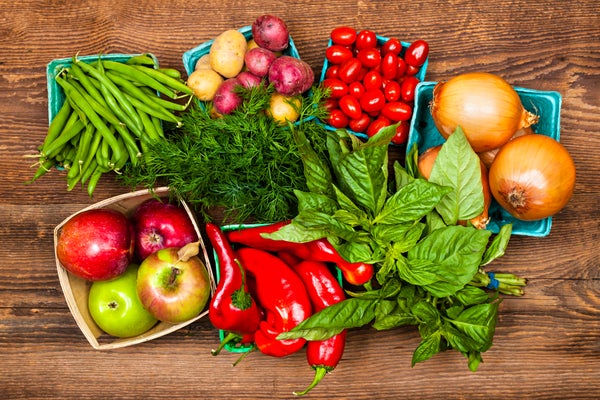
Healthful Diet Switch Helps Even Late in Life

At a Harvard T. H. Chan School of Public Health forum on diet and health, Walter Willett, chair of the school's nutrition department, said that adoption of more healthful eating habits even late in life still has benefits.

Getty Images/iStockphoto Thinkstock Images (MARS)

Illustration of a Bohr atom model spinning around the words Science Quickly with various science and medicine related icons around the text

Join Our Community of Science Lovers!

Let’s say your diet has been not so great. Maybe too much red meat, especially processed meat. Maybe too many sugary soft drinks. And maybe you’ve been eating like that for decades. So what’s the point of trying to make some healthful changes now, after the damage has presumably been done?


“It is impressive that changes even very late in life, such as even being older and having a heart attack, a dietary change can within a matter of a few months drop our risk greatly of a recurrent heart attack or death.”


On supporting science journalism

If you're enjoying this article, consider supporting our award-winning journalism by subscribing. By purchasing a subscription you are helping to ensure the future of impactful stories about the discoveries and ideas shaping our world today.


Walter Willett. He chairs the Department of Nutrition at the Harvard T. H. Chan School of Public Health. He spoke at a January 15th forum on Cancer and Diet that wound up touching on diet and health in general.   


“So it’s never too late to make important changes. For diabetes also, if we change our diet almost immediately our risk of diabetes goes down. But that’s not to say you just should just wait `til you’re old to start living a healthy life. We’re seeing in some studies now that what women ate as adolescents, especially if they ate a lot more red meat, that affected breast cancer risk later in their life. So it’s definitely important if you want the healthiest overall life is to start a healthy lifestyle early. But if you’ve sort of ignored things it’s never too late to still get some benefit.”


The entire hour-long forum featuring Willett and other researchers discussing diet and health is archived on line. Just google “Harvard public health forum”.


—Steve Mirsky


[The above text is a transcript of this podcast.]

It’s Time to Stand Up for Science

If you enjoyed this article, I’d like to ask for your support. Scientific American has served as an advocate for science and industry for 180 years, and right now may be the most critical moment in that two-century history.

I’ve been a Scientific American subscriber since I was 12 years old, and it helped shape the way I look at the world. SciAm always educates and delights me, and inspires a sense of awe for our vast, beautiful universe. I hope it does that for you, too.

If you subscribe to Scientific American, you help ensure that our coverage is centered on meaningful research and discovery; that we have the resources to report on the decisions that threaten labs across the U.S.; and that we support both budding and working scientists at a time when the value of science itself too often goes unrecognized.

In return, you get essential news, captivating podcasts, brilliant infographics, can't-miss newsletters, must-watch videos, challenging games, and the science world's best writing and reporting. You can even gift someone a subscription.

There has never been a more important time for us to stand up and show why science matters. I hope you’ll support us in that mission.

Thank you,

David M. Ewalt, Editor in Chief, Scientific American

Subscribe