Howler Monkeys Trade Testicles for Decibels

Among howler monkey species, loud calls come at the expense of testicle size and sperm production—or to put it another way, monkeys with the largest testes don't make as much noise

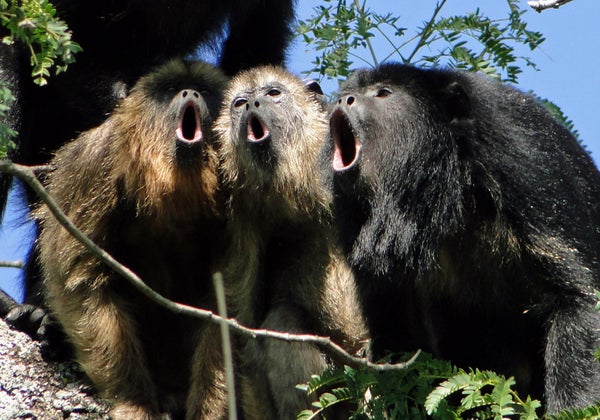
A chorus of howler monkeys of the species Alouatta caraya.

Mariana Raño

Illustration of a Bohr atom model spinning around the words Science Quickly with various science and medicine related icons around the text

Join Our Community of Science Lovers!

[Howler monkey calls]

Howler monkeys. From their Central and South American rainforest home, they produce some of the loudest animal calls in the world. They’re about the size of an adult cocker spaniel, but they can sound as large as a tiger.

Biologists have long suspected that the monkeys’ howls played a role in attracting mates. The sounds are like the auditory version of peacock feathers or deer antlers that say, hey, check me out.


On supporting science journalism

If you're enjoying this article, consider supporting our award-winning journalism by subscribing. By purchasing a subscription you are helping to ensure the future of impactful stories about the discoveries and ideas shaping our world today.


And now we know that the quality of the howl depends on a bone near their throats called the hyoid. The bigger the hyoid, the deeper the howl. Males with deeper calls sound more attractive to females. Which means that males with smaller hyoids had to come up with another strategy.

“When you’re in the field and you look up at the monkeys, you notice that in Alouatta palliata, the mantled howler monkey, that the testes are huge. And they’re white, they’re really obvious.”

University of Utah anthropologist Leslie Knapp. She her team found that howler monkeys face an anatomical trade-off: a species can either have a really big hyoid bone, or it can be very well endowed. But not both. That finding is in the journal Current Biology. [Jacob C. Dunn et al, Evolutionary Trade-Off between Vocal Tract and Testes Dimensions in Howler Monkeys]

Those species with bigger hyoids live in single-male groups, so it makes sense to invest in what the researchers call “precopulatory traits,” that is, their courtship strategy of attracting the female’s attention.

But in a species where groups include multiple males, the best way to ensure passing on more genes is to make more sperm—by building bigger testes.

The researchers say the finding is the first evidence for an evolutionary trade-off between mating calls and sperm production. And they warn that while human women do tend to prefer males with deeper voices, we men advertise ourselves in many other ways as well. So don’t go clicking that pop-up ad that promises to enlarge your hyoid.

—Jason Goldman

[The above text is a transcript of this podcast.]

[Howler monkey sounds from a video courtesy of La Senda Verde Animal Refuge, Bolivia]


Jason G. Goldman is a science journalist based in Los Angeles. He has written about animal behavior, wildlife biology, conservation, and ecology for Scientific American, Los Angeles magazine, the Washington Post, the Guardian, the BBC, Conservation magazine, and elsewhere. He contributes to Scientific American's "60-Second Science" podcast, and is co-editor of Science Blogging: The Essential Guide (Yale University Press). He enjoys sharing his wildlife knowledge on television and on the radio, and often speaks to the public about wildlife and science communication.

More by Jason G. Goldman

It’s Time to Stand Up for Science

If you enjoyed this article, I’d like to ask for your support. Scientific American has served as an advocate for science and industry for 180 years, and right now may be the most critical moment in that two-century history.

I’ve been a Scientific American subscriber since I was 12 years old, and it helped shape the way I look at the world. SciAm always educates and delights me, and inspires a sense of awe for our vast, beautiful universe. I hope it does that for you, too.

If you subscribe to Scientific American, you help ensure that our coverage is centered on meaningful research and discovery; that we have the resources to report on the decisions that threaten labs across the U.S.; and that we support both budding and working scientists at a time when the value of science itself too often goes unrecognized.

In return, you get essential news, captivating podcasts, brilliant infographics, can't-miss newsletters, must-watch videos, challenging games, and the science world's best writing and reporting. You can even gift someone a subscription.

There has never been a more important time for us to stand up and show why science matters. I hope you’ll support us in that mission.

Thank you,

David M. Ewalt, Editor in Chief, Scientific American

Subscribe