
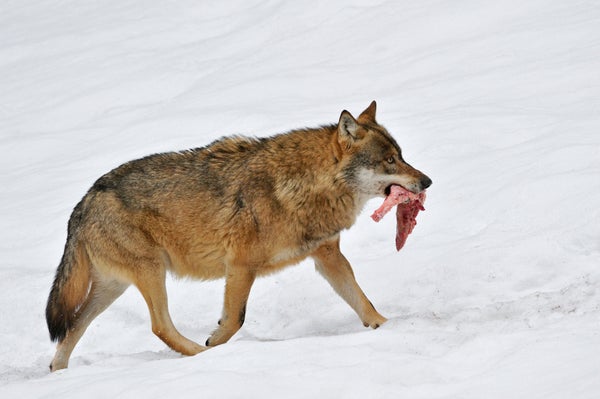

How did dogs become humans’ best friend? Well, one idea is that docile wolves flocked to waste dumps near human camps. But there are problems with that idea.
“Because why would humans tolerate such a dangerous carnivore close to their camping sites?”
Maria Lahtinen is an archaeologist at the Finnish Food Authority and the Natural History Museum in Helsinki.
On supporting science journalism
If you're enjoying this article, consider supporting our award-winning journalism by subscribing. By purchasing a subscription you are helping to ensure the future of impactful stories about the discoveries and ideas shaping our world today.
She points out that hunter-gatherers living during the time of wolf domestication—14,000 to 29,000 years ago— probably didn’t stay put long enough to create generations’ worth of trash. Writing in the journal Scientific Reports, she and her colleagues present a different hypothesis: that humans purposely shared their leftovers with wolves instead. [Maria Lahtinen et al., Excess protein enabled dog domestication during severe Ice Age winters]
Her team calculated the energy content of common Paleolithic prey like moose, deer and caribou. And they found there likely would have been more than enough meat to go around. That’s because humans can’t survive on protein alone—but wolves can for months. So Lahtinen says we might have lobbed the leanest cuts their way.
“This is what we would have given to the dogs—and eaten the organs and bone marrows and the other fatty parts of the animal ourselves.”
In other words, the meaty, pricey bits we prize today would have been what our ancestors threw to the dogs. And sharing our meat might have sparked a deeper relationship, Lahtinen says.
“Because dogs are useful in very many ways, such as guardians, beasts of burden—they can pull a sledge. They can warn us from predators. You can use them as a hunting aid.”
And sooner or later, she says, the domesticated dog was born.
—Christopher Intagliata
[The above text is a transcript of this podcast.]
