
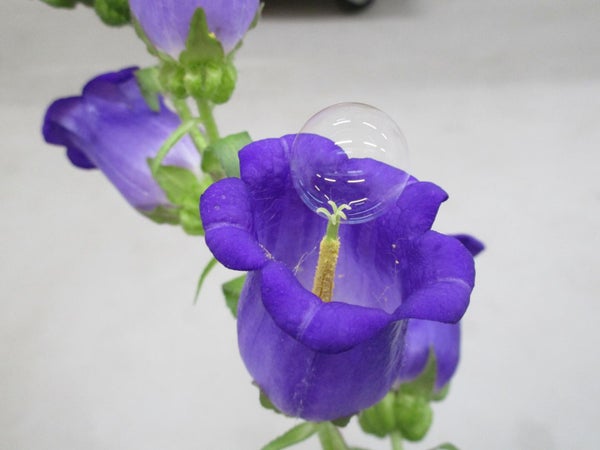

Bees are a big part of the life cycle of plants, carrying pollen from one flower to another and allowing plants to produce their frequently yummy output. But with bee populations on the decline, what can take their place? How about soap bubbles?
It may sound fantastical. But Eijiro Miyako and his colleague at the Japan Advanced Institute of Science and Technology have used battery-powered bubble makers to pollinate a pear orchard. The details of their magical realism approach to agriculture are in the journal iScience. [Xi Yang and Eijiro Miyako, Soap bubble pollination]
A few years back, Miyako and his team tried to mimic the pollinating prowess of honeybees by retrofitting a two-inch-long toy drone with brushes made of horsehair. They loaded the device with pollen suspended in a sticky gel. But the tiny flyer was tough to control. And its hairy little applicators ended up damaging the delicate floral targets.
On supporting science journalism
If you're enjoying this article, consider supporting our award-winning journalism by subscribing. By purchasing a subscription you are helping to ensure the future of impactful stories about the discoveries and ideas shaping our world today.
After spending some time blowing bubbles with his son, Miyako started thinking more seriously about these soapy little marvels. He figured bubbles would be sticky enough to carry and deliver a pollen payload but soft and flexible, so they shouldn’t hurt a blossom when they land and then pop.
The researchers chemically optimized their soapy solution to make bubbles that were mechanically stable and actually enhanced the pollination process.
Out in the orchard, they aimed their souped-up soap bubbles at row after row of pear trees. And they found the bubble system worked just as well as the more labor-intensive pollination by hand: pear trees pollinated by bubble ultimately bore fruit—a sweet sign of success.
Miyako has also revived the drone program—this time using a larger model—equipped with a machine that unleashes a bubble blitz. And has a big advantage over the hand-held model ...
“Because it’s fully autonomously controllable by GPS with Google Map.”
So the drones can make a beeline to where farmers need them, you know, to be.
—Karen Hopkin
[The above text is a transcript of this podcast.]
