

The goal for a lot of tech companies today: figure out what you, their customer, want next, before you even ask. It's driven by something called similarity search.
"If you go to YouTube and you watch a video they're going to suggest similar videos to the one you're watching. That's similarity search. If you go to Amazon and look for similar products to the one you're going to buy, that's similarity search."
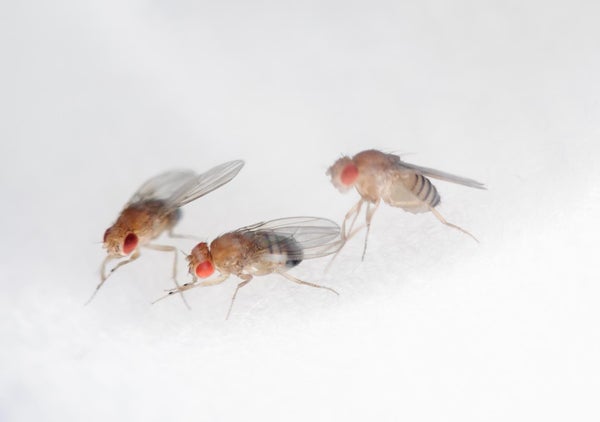
Saket Navlakha, a computer scientist at the Salk Institute. He says we do similarity searches, too, for example, when we scan faces in a crowd for the one we know. And even fruit files do a version, related to smell:
On supporting science journalism
If you're enjoying this article, consider supporting our award-winning journalism by subscribing. By purchasing a subscription you are helping to ensure the future of impactful stories about the discoveries and ideas shaping our world today.
"So the fly is having to solve a similar problem, of kind of searching through its database of previous experiences and previous odors it has smelled, to determine what should be the most appropriate behavioral response to that odor."
But flies tag incoming odors differently from the way modern search algorithms parse similarity. A small group of neurons makes an initial evaluation of the smell. Then a much larger set of neurons is activated to make a final decision about the smell. Rather than the way a computer similarity search does it, taking something with many dimensions, and simplifying it down to a few.
So Navlakha and his colleagues tweaked computer similarity search functions to do it fly style. And then pitted the fly-inspired algorithms against conventional ones. And the biologically inspired code won out, better at telling "like" from "unlike" on an image-similarity test.
"You know evolution figured it out, it figured out a very elegant solution to this very important problem." The report is in the journal Science. [Sanjoy Dasgupta et al., A neural algorithm for a fundamental computing problem]
Navlakha says he and his team are looking to partner with tech companies now, in hopes of endowing machines with the time-tested problem-solving abilities of the brain. Even if it’s a fruit fly brain.
—Christopher Intagliata
[The above text is a transcript of this podcast.]
