
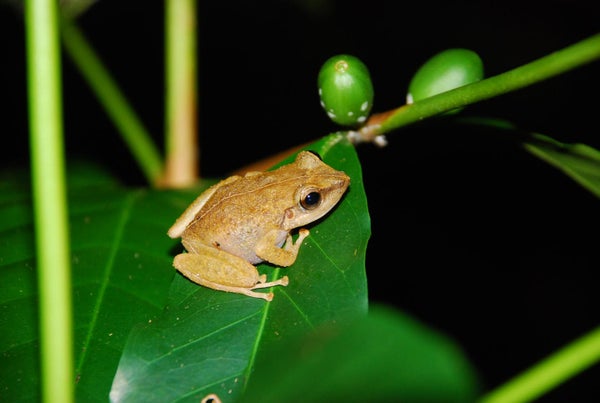

Coquí frogs. They’re named for the sound they make.
The animals and their nocturnal chirps are beloved in their native Puerto Rico. But not in Hawaii, where they became invasive in the late 1980s.
The frogs have become a nuisance in part because they cause people to lose sleep, which has actually driven down property values. But some of Hawaii's endangered insect species could face extinction due to the hungry invaders. Biologists also feared that the frogs could impact Hawaii's insect population to such an extent that native birds that also eat insects could go hungry.
On supporting science journalism
If you're enjoying this article, consider supporting our award-winning journalism by subscribing. By purchasing a subscription you are helping to ensure the future of impactful stories about the discoveries and ideas shaping our world today.
A group of researchers has now put that concern to the test by looking at thirty sites on the big island—half that were infested with coquís, and half that were still coquí-free.
"And we didn't see any response in the native birds. They seem to be doing fine with the coquís. At least their abundances were similar in places where there were coquís, and not coquís."
University of Utah ecologist Karen Beard.
"But it was the nonnative birds where we really saw the response. And we didn't see it in a negative way."
Three types of nonnative birds were actually more abundant in areas with more frogs.
"And we were like, huh. That's kind of interesting."
The researchers think they can explain this in two parts: coquís forage in leaf litter while Hawaii's native insect-eating birds forage in the canopy and understory, so they may be going after different types of prey. Meanwhile, the nonnative birds may be getting a boost by eating the frogs themselves. After all, a fingernail sized baby coquí frog is about the same size as a typical rainforest insect. The study is in the journal The Condor. [Robyn L. Smith, Karen H. Beard, & David N. Koons. Invasive coquí frogs are associated with greater abundances of nonnative birds in Hawaii, U.S.A.]
Despite these findings, coquí frogs could still harm Hawaii's native birds—indirectly.
"If there's a lot more nonnative birds, there's a lot more nonnative bird nests. That could do something like increase rat and mongoose populations, which are known to be nest predators of native birds."
Hawaii has stopped attempting to eradicate the big island of the invasive hoppers, where some spots may have 10 million coquis per square kilometer. Instead, the focus is on keeping them from expanding even further into the rainforest. To protect local species—and allow them to get some sleep.
—Jason G. Goldman
[The above text is a transcript of this podcast.]
