
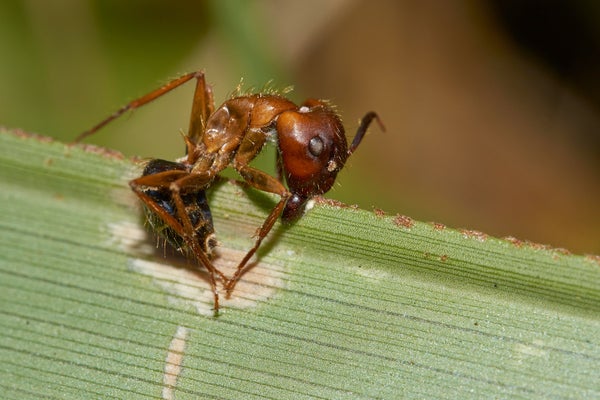

It's straight out of a horror movie: an ant, infected with a fungus, starts behaving strangely. It crawls as high as it can in the forest, grabs a leaf or twig in its mouth and bites. Hard.
"It enters into this 'death-grip phenotype' is what we call it." Colleen Mangold, a molecular biologist at Penn State. "And then a couple hours after initiation of that behavior the ant will die."
The fungus, known as Ophiocordyceps, then eats through the corpse and sprouts a stalk from the ant's body to release more spores and infect more ants. It's a harsh way to go.
On supporting science journalism
If you're enjoying this article, consider supporting our award-winning journalism by subscribing. By purchasing a subscription you are helping to ensure the future of impactful stories about the discoveries and ideas shaping our world today.
"It's not ideal, definitely not ideal."
Mangold and her colleagues wanted to get to the bottom of why the ants do this—specifically, how they get their death grip. So they dissected infected ants and zoomed in on their jaw muscles with electron microscopes.
They saw that the fungus had invaded and grown into jaw muscle cells, perhaps to suck up nutrients. And they spotted lots of mysterious tiny particles, which might be produced by the ant's immune system—or by the fungus, as a way of communicating with the muscle and forcing it to contract.
Whatever the mechanism, they found that the ant's jaw muscles had contracted so hard, they'd been irreparably damaged. The full details—and gory pictures—are in the Journal of Experimental Biology. [Colleen A. Mangold et al., Zombie ant death grip due to hypercontracted mandibular muscles]
Mangold hopes to get to the bottom of what those tiny particles do in follow-up work. And in the meantime, unless you're a carpenter ant, rest assured you have nothing to worry about.
"It's highly species specific. I seriously doubt we'll be seeing any real-life human zombies anytime soon."
—Christopher Intagliata
[The above text is a transcript of this podcast.]
