
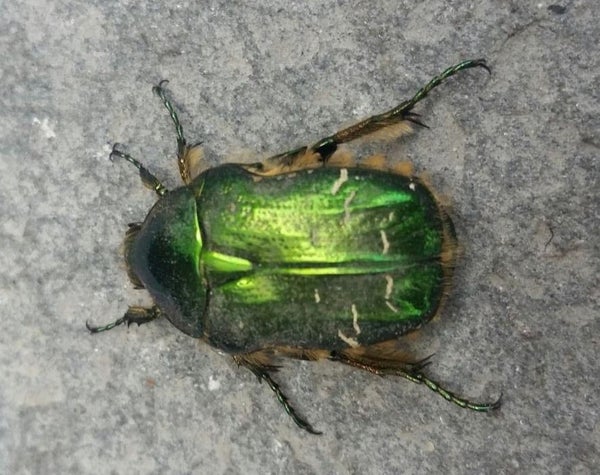

A good disguise keeps you hidden, right? Well, sometimes the best disguise is actually the most dazzling. Because research reveals that flashy metallic iridescence can visually baffle predators. Which allows colorful prey to survive another day. Those eye-popping results appear in the journal Scientific Reports. [Karin Kjernsmo et al., Iridescence impairs object recognition in bumblebees]
Shimmering iridescent coloration…which changes depending on the angle from which it’s viewed…is favored by everything from birds to beetles and and blossoms to butterflies.
“And in our research group we are of course interested in why this vivid metallic coloration is so taxonomically widespread in nature.”
On supporting science journalism
If you're enjoying this article, consider supporting our award-winning journalism by subscribing. By purchasing a subscription you are helping to ensure the future of impactful stories about the discoveries and ideas shaping our world today.
Karin Kjernsmo of the University of Bristol. She says that in some cases the showy splashes of light are a sexual strategy.
“Here I would like to point out that in some species, particularly those that display strong sexual dimorphism, such as birds of paradise or the pea fowl or even in some butterflies or fishes, the occurrence of iridescence is most likely driven by sexual selection. For example, in many of these cases it is the males that have these vivid iridescent colors and they use them in mate choice or they use them as a signal to attract mates.”
But iridescence also shows up in situations where reproduction is not an issue…for example, in caterpillars or chrysalises.
“So what we are studying now is whether natural selection imposed by predation could explain the occurrence of iridescence in prey animals.”
The idea that eye-catching colors could be used as a cover-up isn’t a new one.
“The father of camouflage theory, Abbott Thayer, he really believed that iridescence should be categorized as a camouflage strategy. And he wrote in his famous lifework Concealing-Coloration in the Animal Kingdom, already in 1909, that “brilliantly changeable or metallic colors are among the strongest factors in an animal’s concealment.” And this sounds like a completely counterintuitive thing to say, because how can colors that are both brilliant and changeable contribute to animal’s concealment?”
After all, when we think of camouflage, we tend to think about blending in to the background. But there are forms of camouflage…called disruptive coloration…that work by breaking up an animal’s otherwise tell-tale shape.
“In a similar way, we were asking whether iridescence, due to its changeability, could work as a form of camouflage by obstructing shape recognition.”
Kjernsmo and her colleagues trained bumblebees to associate a particular shape… a circle or an oval…with a sugar reward. And they found that the bees, when given a choice, would preferentially visit the shape they knew to be sweet. But when the shapes were iridescent, the bees had trouble telling them apart.
“It seemed that the strikingly iridescent surfaces on our targets visually broke up the otherwise recognizable shape of the targets.”
Which made them hard to distinguish.
As for making use of this method for hiding in plain sight…
“Any practical applications is of course directly linked to any industry that has an interest in camouflage, that is how to conceal objects or make them more difficult to recognize.”
The researchers are currently conducting experiments with birds…which often include iridescent insects in their diet. To see if it helps to have a bird’s-eye view.
—Karen Hopkin
[The above text is a transcript of this podcast.]
