
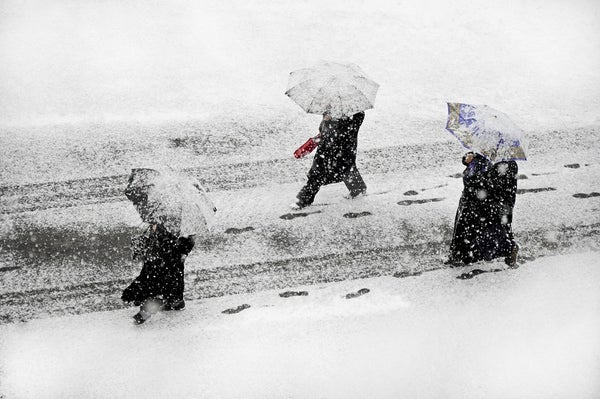

Global warming deniers love to point to cold or snow as evidence against climate change. Like Oklahoma Senator James Inhofe. Remember last year, when he tossed a snowball in Congress? "You know what this is? It's a snowball. It's very, very cold out." With that, he offhandedly disproved decades of climate science. To some people.
But such cold-influenced-denial may be playing out across the U.S., in particular in Appalachia and the South. Because it turns out those areas have had lots of record low temperatures in the last 12 years. And they're also by and large the same parts of the country that have high numbers of global warming skeptics. So researchers have a theory that personal experience with cold snaps could be trumping scientific facts. The analysis is in the Proceedings of the National Academy of Sciences. [Robert K. Kaufmann et al., Spatial heterogeneity of climate change as an experiential basis for skepticism]
Study author Robert Kaufmann, an environmental scientist at Boston University, says the way around this might be to put climate data in terms people understand: money. "We should propose a simple bet to climate skeptics. And that is: For every new record high temperature at a weather station, you pay us a dollar. And for every new record low temperature, we'll pay you a dollar."
On supporting science journalism
If you're enjoying this article, consider supporting our award-winning journalism by subscribing. By purchasing a subscription you are helping to ensure the future of impactful stories about the discoveries and ideas shaping our world today.
Or, he says, think of climate change as a slot machine, especially with the president-elect. “He's run casinos. So you can kind of think of climate like a climate casino. If you were a casino owner and you had a machine that was constantly paying out more record high temperatures than more record low temperatures, you would look into that machine. Something's wrong with the machine. And that's what the climate machine has been doing."
However you think about it, Kaufmann won't be betting. "I got no dough, man, I'm an academic."
—Christopher Intagliata
[The above text is a transcript of this podcast.]
