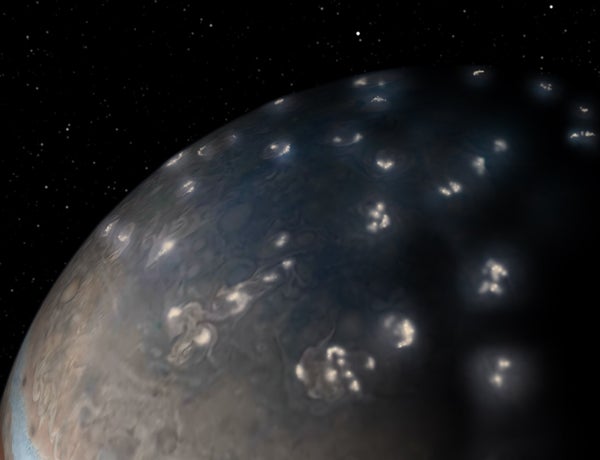
Thirty-nine years ago, Voyager 1 swung by Jupiter on its journey to interstellar space. As it did, it picked up spooky low-frequency radio signals
The whistlers, as they're known, were radio broadcasts from unusual, natural antennas: lightning bolts, which act like radio transmitters, with current moving through a channel.
Along with photos of the dark side of the planet, the whistlers confirmed the existence of lightning on Jupiter. But the limited observations made it hard to pin down where electrical storms gathered… and the bolts were thought to be rare, compared to Earth.
On supporting science journalism
If you're enjoying this article, consider supporting our award-winning journalism by subscribing. By purchasing a subscription you are helping to ensure the future of impactful stories about the discoveries and ideas shaping our world today.
Now the Juno spacecraft has detected the first high-frequency radio signals, and 1,600 new whistlers ..., which together suggest lightning on Jupiter is much more common than scientists thought. And a lot more similar to Earth lightning, too. The discharges also appear to be between clouds containing liquid water and others containing water ice…, the same kind of conditions for cloud-to-cloud lightning here on Earth.
The findings appear in the journals Nature and Nature Astronomy. [Ivana Kolmašová et al., Discovery of rapid whistlers close to Jupiter implying lightning rates similar to those on Earth and Shannon Brown et al., Prevalent lightning sferics at 600 megahertz near Jupiter’s poles]
There is one twist to this Jovian weather story: Jupiter's lightning storms congregate near the planet's poles, not its equator—the opposite of Earth. A detail that makes this familiar phenomenon still seem a bit otherworldly.
—Christopher Intagliata
[The above text is a transcript of this podcast.]
Subscribe to Support Independent Journalism
Great science journalism requires human expertise, time, effort and creativity. And it costs money. That’s why I and the journalists here at Scientific American hope you’ll join our community.
When you subscribe, you are supporting staff and freelance journalists who are passionate about telling science stories that are true, important and compelling. Our editors and reporters are often experts in their fields, which means they understand the nuances of big discoveries and can untangle the breakthroughs from the hype. With a subscription, you are also supporting rigorous fact-checking to ensure the words we publish are precise and accurate. And you’re supporting original illustrations, graphics and photos that bring you closer to an advanced laboratory, an ice sheet in Antarctica or a space mission in orbit. You’re helping us craft other types of high-quality journalism as well: Our newsletters are carefully written, edited and curated by staffers you have or will come to know and love. Our Science Quickly podcast is based on original reporting, collaboration with editors and scientists and exacting production.
Subscriptions keep this engine running so we can continue to deliver thoughtful, rigorous and independent science journalism to you. In an era of viral misinformation, this work is crucial. If you value what we do, I hope you’ll consider joining us as a subscriber