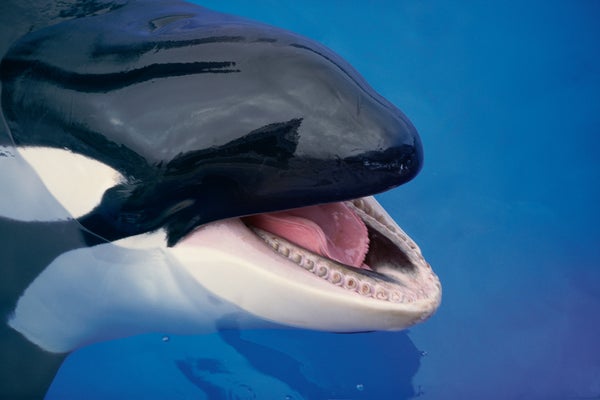
Killer whales, also called orcas, are like dolphins and belugas—they all have a wide vocal repertoire. <> But orcas also have unique dialects among different pods. Which suggests the animals can learn new and unique sounds by imitating mom, or another whale.
Researchers tested that premise by asking a killer whale named Wikie to imitate novel sounds from another killer whale, like this [Wolf sound] or this [creaking door sound].
And then: Wikie's trainers asked her to imitate them speaking English. Here's how she did: ["Amy, hello"]
On supporting science journalism
If you're enjoying this article, consider supporting our award-winning journalism by subscribing. By purchasing a subscription you are helping to ensure the future of impactful stories about the discoveries and ideas shaping our world today.
Pretty impressive, especially because she's using her nasal passages to imitate sounds we make with our vocal cords.
And a technical acoustic analysis of the original and imitated sounds showed that Wikie was doing a reliable job of mimicry, suggesting orcas do indeed possess the ability of vocal imitation. The study is in the Proceedings of the Royal Society B. [Jose Z. Abramson et al., Imitation of novel conspecific and human speech sounds in the killer whale (Orcinus orca)]
So how long before Wikie's fluent in English? Well: "This is not our goal." Study author José Zamorano-Abramson, a comparative psychologist. "We are focusing on one aspect of vocal language, which is the capacity for vocal imitation." Because the ability to imitate implies a way to transmit culture… and preserve each orca pod's unique repertoire. ["bye bye"]
—Christopher Intagliata
[The above text is a transcript of this podcast.]
Subscribe to Support Independent Journalism
Great science journalism requires human expertise, time, effort and creativity. And it costs money. That’s why I and the journalists here at Scientific American hope you’ll join our community.
When you subscribe, you are supporting staff and freelance journalists who are passionate about telling science stories that are true, important and compelling. Our editors and reporters are often experts in their fields, which means they understand the nuances of big discoveries and can untangle the breakthroughs from the hype. With a subscription, you are also supporting rigorous fact-checking to ensure the words we publish are precise and accurate. And you’re supporting original illustrations, graphics and photos that bring you closer to an advanced laboratory, an ice sheet in Antarctica or a space mission in orbit. You’re helping us craft other types of high-quality journalism as well: Our newsletters are carefully written, edited and curated by staffers you have or will come to know and love. Our Science Quickly podcast is based on original reporting, collaboration with editors and scientists and exacting production.
Subscriptions keep this engine running so we can continue to deliver thoughtful, rigorous and independent science journalism to you. In an era of viral misinformation, this work is crucial. If you value what we do, I hope you’ll consider joining us as a subscriber