

It’s not easy to study the early development of the human brain.
“The brain is very inaccessible, especially the early fetal stages. It’s just not ethical to study normal, healthy human brains.”
University of California, San Diego, biologist Alysson Muotri. He says researchers have instead relied on animal models.
On supporting science journalism
If you're enjoying this article, consider supporting our award-winning journalism by subscribing. By purchasing a subscription you are helping to ensure the future of impactful stories about the discoveries and ideas shaping our world today.
“But the human brain is so much different from other species that we’re desperate to have, really, a human model so we can study the human brain.”
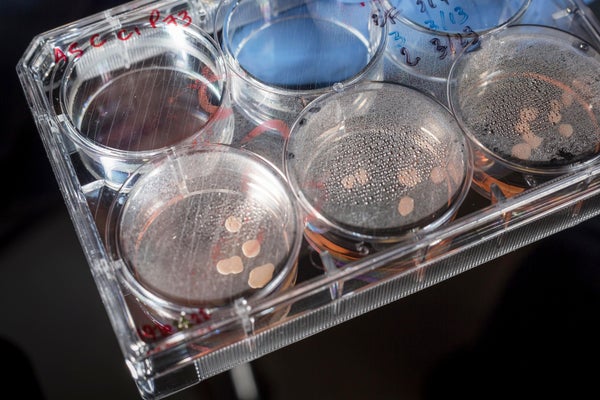
Now Muotri’s team may have that model, in the form of small globules of brain cells they’ve created in the lab. These pea-sized structures develop from stem cells that are bathed in a culture of nutrients, along with proteins that control gene activation. As the little structures grow, their constituents also specialize into different types of brain cells.
“And they willform connections, and these connections will form functional synapses that will, later on, turn into networks.”
After two months, the mini brains even begin to emit brain waves.
“And you can record every week to see how the activity has changed. And when they reach about six months of age, we see a growth exponentially in the number of connections and synapses that they can make.”
And at around 10 months, their brain activity compares to that of premature human infants.
“They’re pretty much followingthesame trajectory as the human brain does.”
That could make the mini brains very useful for understanding how our brains become wired early on. And they could also provide insights into the development of neurological conditions such as autism and epilepsy.
“These very early stages are exactly when some neurological conditions appear. And we have the possibility to help millions of people with neurological conditions.”
But Muotri also cautions that as the technology moves forward, ethical questions will start to emerge.
“Someone might ask, ‘Are they conscious or are they self-aware? Can they feel pain?’ I think we are in a gray zone, where this technology could evolve to something more complex. And then I think the ethical question would be, ‘What’s the moral status of these miniaturized brains?’”
Muotri says that same question has formed the basis for the rules and regulations governing the use of animals in the lab, which can serve as a model to guide the mini brain research. The findings are in the journal Cell Stem Cell. [Cleber A. Trujillo, et al., Complex oscillatory waves emerging from cortical organoids model early human brain network development]
In addition to shedding light on neurological development, mini brains could also help reveal how the human brain evolved and play a role in improving algorithms for artificial intelligence. These pea-sized brains may produce some big insights.
—Susanne Bard
[The above text is a transcript of this podcast]
