
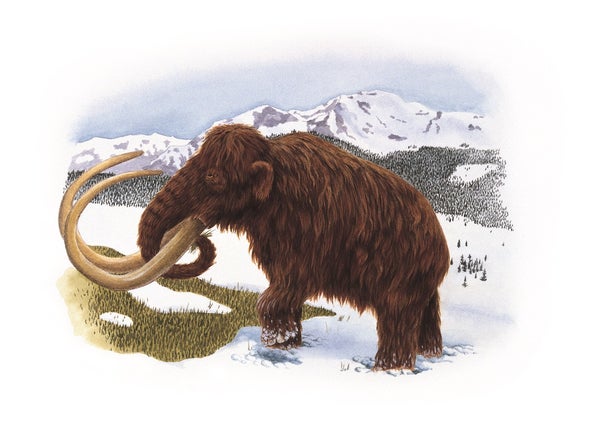

In their heyday, woolly mammoths blanketed the Siberian steppe, Alaska and large parts of North America. But by 10,000 years ago, warming climates had turned many of the grasslands they grazed into forest. And humans, well they weren't so friendly either—one mammoth provides quite a feast. So the mammoths largely disappeared. Except there's this one holdout population. On an island in the Arctic Ocean, called Wrangel Island. Where the last mammoths hid out…for more than 6,000 years.
"So the pyramids have been built, they've started to grow tea in China, and civilization had formed, and here are these mammoths no one knew was there, for the longest period of time." Rebekah Rogers, an evolutionary geneticist at the University of North Carolina. "And then people finally found this island around 3,700 years ago, around the time they went extinct."
Rogers and her colleague Montgomery Slatkin analyzed the genome from the tooth of one of those island mammoths, which lived 4,300 years ago. They compared it to the genome of a mainland mammoth, from much farther back, 45,000 years. And they found that harmful mutations had polluted the island mammoth's genome in that time interval. Mutations that led to the loss of smell receptors, and urine proteins—compounds they probably needed for social signaling and mate choice.
On supporting science journalism
If you're enjoying this article, consider supporting our award-winning journalism by subscribing. By purchasing a subscription you are helping to ensure the future of impactful stories about the discoveries and ideas shaping our world today.
The animals also developed this satiny coat, that shines in the light. A trait that's actually popular for pet breeders today, for rabbits and guinea pigs. And the reason for all these mutations? Rogers says there just weren't enough individuals on the island—1,000 at the most, 300 at their lowest—to allow natural selection to run its course. So it wasn't survival of the fittest. It was survival of… whoever randomly survived. Which meant they accumulated a lot of mutations. None of which made them drop dead—but they weren't all that fit, either. The study is in the journal PLoS Genetics. [Rebekah L. Rogers, Montgomery Slatkin: Excess of genomic defects in a woolly mammoth on Wrangel island]
Rogers says a similar process could happen for rare animals on Earth today, like cheetahs, pandas, gorillas. "If you have a very small population for a very long time you can get this accumulation of bad mutations in their genomes. And so we'd expect to see the same effect for them. It does take a long time period to get a signal as big as what we saw in the mammoths, so the earlier we can intervene for those species, the better off they'll be."
As for those humans who, long ago, found this last holdout of mammoths on Wrangel Island? "We don't have direct evidence they hunted them, but you kind of wish that they had taken them back and domesticated them." There's already one interested buyer. "Oh yes, if you can find one I would like to have one as a pet. Preferably a little smaller so it fits in my house."
—Christopher Intagliata
[The above text is a transcript of this podcast.]
