

Large mammals can be lost from a particular place, from being hunted or by the destruction of their habitat. And the loss of these big animals can greatly affect the rest of the ecosystem. Take elephants: They can leave deep footprints in soil. After it rains, each footprint becomes a tiny pond, which becomes a home to a variety of invertebrates. No elephants means no homes for those critters. So while it’s well known that the loss of large mammals can mean bad news, just how pervasive those impacts can be still remains unclear.
“I spent a lot of time when I was there in these heavily hunted forests. And in these relatively pristine forests, they were pretty protected. Just walking around, I was noticing that there’s a visual difference in the amount of understory vegetation in these areas where the elephants and other large animals like forest buffalo are hunted out. There was a lot more vegetation in the understory, compared to deep within the park, where it was more protected and remote. It was a lot easier to walk around.”
Rice University biologist Therese Lamperty, who conducted fieldwork in Gabon in West Central Africa.
On supporting science journalism
If you're enjoying this article, consider supporting our award-winning journalism by subscribing. By purchasing a subscription you are helping to ensure the future of impactful stories about the discoveries and ideas shaping our world today.
“If overhunting is allowing this vegetation to be released from herbivory and trampling, I was imagining that would probably do a lot to the understory environment and the microclimates invertebrates are exposed to.”
So Lamperty and her team compared the understory vegetation and biodiversity within hunted and protected areas in northeastern Gabon. They discovered that areas with fewer larger mammals indeed had a thicker understory, as Lamperty suspected. And there were fewer termites—which is not good.
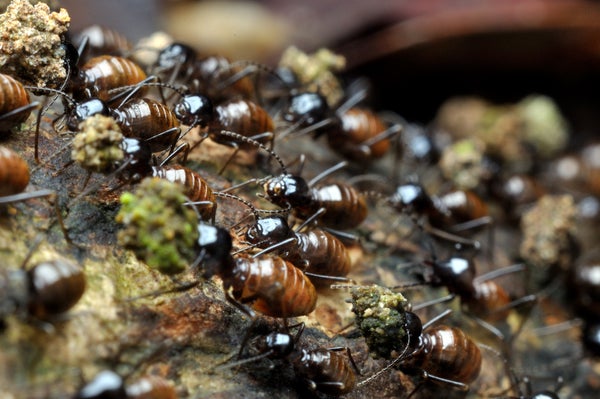
Termites help decompose plants and, as a result, are vital for storing carbon underground. They are also food for a variety of predators. The researchers suspect that the lack of elephant dung and trampled brush removed two important sources of nutrition for the social insects. And that led to a huge decline in termite populations, down by more than 99 percent.
The results are in the journal Biological Conservation. [Therese Lamperty et al., Defaunation of large mammals alters understory vegetation and functional importance of invertebrates in an Afrotropical forest]
But with termites gone, other organisms picked up the slack.
“The termites and invertebrates on the forest floor that we had been sampling were contributing less to decomposition in the hunted forest. But the overall rate didn’t change, so maybe fungus or something else is able to pick up the slack.”
In other words, while the community of organisms that break down dead plants is different in hunted versus intact ecosystems, the overall work that they do remained fairly constant. According to Lamperty, that means that these ecosystems are equipped to deal with these human-caused changes, at least to a point.
“Invertebrates contribute a lot to nutrient cycling, so that’s going to influence how healthy a forest is and its own regeneration processes, which means how much carbon it can store. So that directly affects climate change.”
Our planet has been losing large mammals for a long time, and if current trends continue, some researchers believe the largest terrestrial mammal in 200 years could well be the domestic cow. And we need to understand what that world might look like.
—Jason G. Goldman
[The above text is a transcript of this podcast.]
