
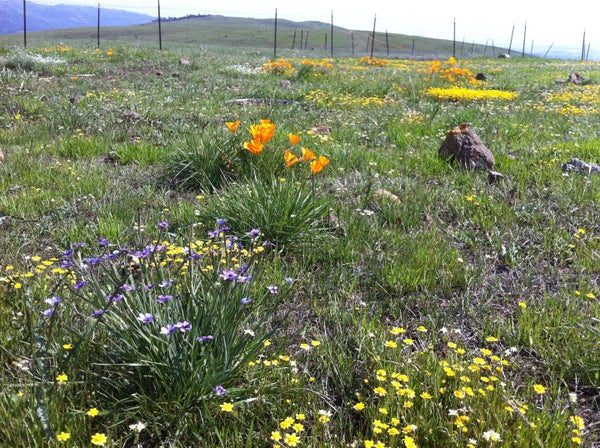

As climate change dials up global temperatures, one effect is an earlier flower bloom. But it turns out there's another factor that also means faster flowering: a loss in biodiversity in a flower field.
"The amount of change in flowering time that we see with diversity loss is in the same magnitude range as the amount of change in flowering time we see with rising temperatures, globally." Amy Wolf, an ecologist at Columbia University and U.C. Davis.
Wolf and her colleagues studied that effect in a grassland in northern California, in study plots with two to 16 species of plants. And they found that, for every two species lost, the remaining flowers blossomed a day earlier, on average. Possibly because the less diverse plots had higher soil temperatures, more moisture, and more nitrogen—all variables that could tweak bloom time. The study is in the Proceedings of the National Academy of Sciences. [Amelia A. Wolf et al., Flowering phenology shifts in response to biodiversity loss]
On supporting science journalism
If you're enjoying this article, consider supporting our award-winning journalism by subscribing. By purchasing a subscription you are helping to ensure the future of impactful stories about the discoveries and ideas shaping our world today.
The reason it matters? Because flowers might bloom earlier than pollinators are expecting them. "And that could lead to a whole cascade of things. If plants don't get pollinated, or they don't get pollinated well, then you can start to lose species at an even more rapid rate."
Wolf says it's too soon to know whether biodiversity loss and climate change will have synergistic effects on flower timing. But combine climate change, species loss, and unpredictable ecological effects like this—and you've got a pretty ugly arrangement.
—Christopher Intagliata
[The above text is a transcript of this podcast.]
