
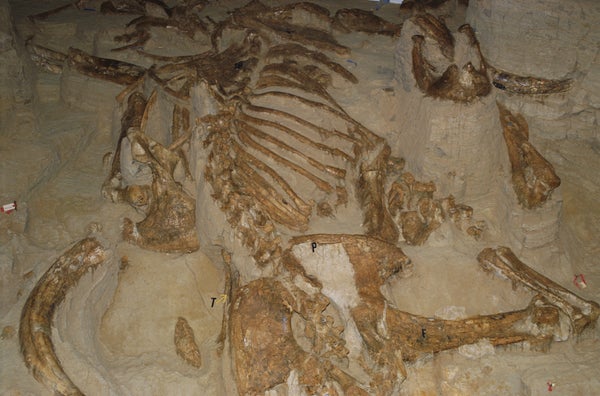

Woolly mammoths once ruled the northern reaches of our planet—roaming from Portugal to Siberia, and beyond to Alaska, Canada and the American Midwest. And the massive beasts left lots of fossil evidence of their occupation.
But now scientists have noticed a strange trend among those mammoth remains. The researchers genetically analyzed the fossilized bones, teeth and tusks of 98 individual Siberian mammoths. And they found that 70 percent of the mammoths…were males.
"So essentially we think this is driven by two different things." Love Dalén, a paleogeneticist and professor at the Swedish Museum of Natural History in Stockholm. "In general, in wild animals, males tend to be more risk-taking."
On supporting science journalism
If you're enjoying this article, consider supporting our award-winning journalism by subscribing. By purchasing a subscription you are helping to ensure the future of impactful stories about the discoveries and ideas shaping our world today.
The second thing, if modern elephant culture is any indication, is that male mammoths may have been solitary loners. More likely to crash through thin ice and sinkholes, or get caught in a mudslide than females. These types of death are more likely to become preserved—so those are the remains that we find. The study is in the journal Current Biology. (Pecnerova et al., Genome-Based Sexing Provides Clues about Behavior and Social Structure in the Woolly Mammoth, Current Biology)
Dalén says this is an important reminder that the fossil record is far from complete. "The fossils we find might not always be representative of the species back when it lived." But with a little detective work, even seemingly random remains have much to reveal.
—Christopher Intagliata
[The above text is a transcript of this podcast.]
