

The Curiosity Rover was never fully sterilized before it touched down on Mars. And there’s been debate whether the rover drill might contaminate certain subsurface areas thought to potentially harbor life. But it turns out the rover may not need to physically drive somewhere to pollute that spot with Earth’s microbes. Because if there are any tiny earthlings on the rover, the strong winds on Mars might be able to spread them around the Red Planet instead.
“Wind storms are very common on Mars on the planetary scale. So you have one point of contamination, and given the proper conditions, you could disperse whatever you were carrying there to distant places.”
Armando Azua-Bustos, a research scientist at the Center for Astrobiology at the Superior Council of Scientific Research in Spain.
On supporting science journalism
If you're enjoying this article, consider supporting our award-winning journalism by subscribing. By purchasing a subscription you are helping to ensure the future of impactful stories about the discoveries and ideas shaping our world today.
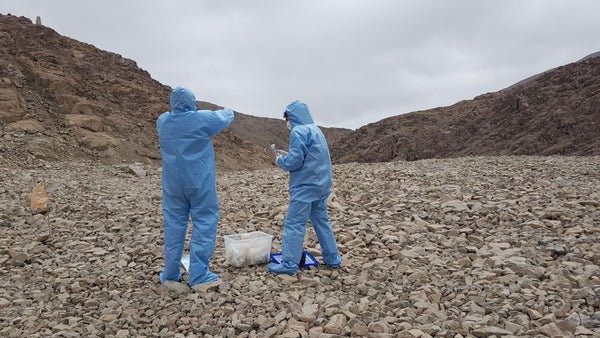
Azua-Bustos is now more certain that such spread might be possible because of an experiment his team carried out in Chile’s Atacama Desert—the conditions of which make it a popular Mars analogue. There, his team placed petri dishes along two paths cutting from the coast into the driest parts of the Atacama. One path was 30 miles long; the other 40 miles long. They waited for winds to deliver coastal dust to the plates. Then they grew whatever landed.
On both paths, they found a multitude of viable bacterial and fungal species, which suggests that microbes are indeed able to fly over the driest and most UV-blasted desert on Earth in just a matter of hours—and arrive unharmed. The details are in the journal Scientific Reports. [Armando Azua-Bustos et al., Aeolian transport of viable microbial life across the Atacama Desert, Chile: Implications for Mars]
The researchers say wind could therefore be a way to easily contaminate another planet with Earth microbes if spacecraft aren’t sterilized—or a way for Martian life in once-fertile areas to hitchhike to others by flying on dust in the wind.
—Christopher Intagliata
[The above text is a transcript of this podcast.]
