
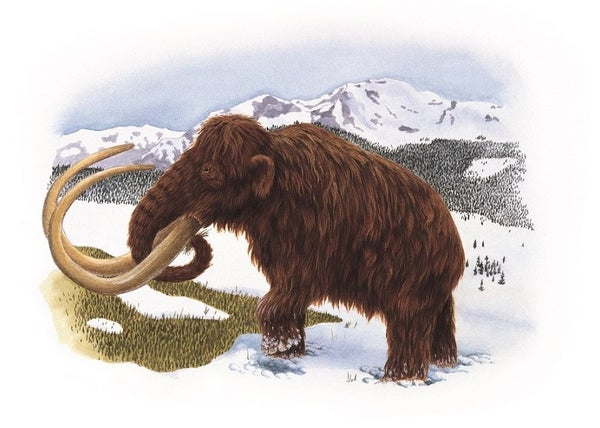

The Explorers Club in New York City—whose members have included Neil Armstrong, Teddy Roosevelt, and the first men to reach both the North and South poles—has a reputation for serving exotic entrees, like fried tarantula and goats’ eyeballs. In 1951 the dinner menu featured Pacific spider crabs, turtle soup, bison steak and—allegedly scavenged from glacial ice off the coast of Alaska—a mound of mammoth meat.
One club member who couldn’t make the dinner asked to be sent a doggie bag, which he promptly donated to the Bruce Museum in Greenwich, Connecticut. What was particularly odd—odder than displaying leftovers in a museum—was that the mammoth meat was labeled Megatherium, a giant extinct ground sloth native to South America.
So which was it: mammoth or monster sloth? To find out 64 years later, researchers sequenced some mitochondrial DNA they extracted from the preserved prehistoric takeaway. What they found is that the source of the sample was neither mammoth nor sloth. It was actually sea turtle—meat that likely contributed to both the main course and that turtle soup appetizer.
On supporting science journalism
If you're enjoying this article, consider supporting our award-winning journalism by subscribing. By purchasing a subscription you are helping to ensure the future of impactful stories about the discoveries and ideas shaping our world today.
That’s the forensic finding served up in the journal PLoS ONE. [Jessica R. Glass et al., Was Frozen Mammoth or Giant Ground Sloth Served for Dinner at The Explorers Club?]
Of course, a double order of sea turtle might not be as exciting as a mouthful of mammoth or a soupçon of sloth. But it may be easier to swallow.
—Karen Hopkin
[The above text is a transcript of this podcast.]
