
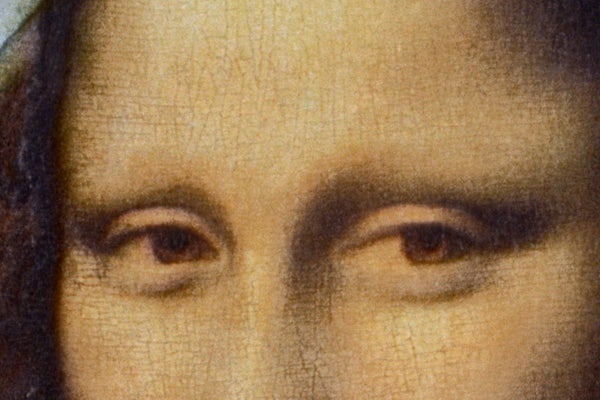

Leonardo da Vinci'smost famous painting also has an optical illusion named after it: the Mona Lisa effect. The feeling that the subject of a painting follows you with her gaze. "You continuously feel like you're being looked at, despite moving to the left, to the right, perhaps even rotating the picture."
Sebastian Loth is a psychologist at the University of Bielefeld in Germany. And while he doesn't dispute that the illusion itself exists—you've probably also seen it in the Uncle Sam Army recruitment poster—he says there's a problem with the phenomenon's name.
"I can show you so many papers where people have literally started their introduction with 'We all know that Mona Lisa looks at you,' and so on and so forth, and then they'd go into their argument, whatever it is, but actually she, in this specific picture, doesn't look at you."
On supporting science journalism
If you're enjoying this article, consider supporting our award-winning journalism by subscribing. By purchasing a subscription you are helping to ensure the future of impactful stories about the discoveries and ideas shaping our world today.
He and his colleague Gernot Horstman conducted a scientific investigation of this claim by sitting 24 volunteers in front of a computer screen, which displayed various magnifications of the Mona Lisa. They placed rulers at two distances between the subjects and the screen. Then asked the subjects to indicate where on the rulers the Mona Lisa's gaze intersected.
"And then you can compute a line, that's basically school mathematics here, and then you can figure out the angle. And what came out was 15 degrees to the right." So the Mona Lisa actually stares over the viewer's right shoulder, he says. Not straight out of the canvas—the key to creating her namesake illusion. The write-up is in the journal i-Perception. [Gernot Horstmann & Sebastian Loth, The Mona Lisa Illusion—Scientists See Her Looking at Them Though She Isn’t]
Loth says effects like these can have modern implications, for example, when building virtual assistants on computers, which might need to speak to—and make eye contact with—more than one person in a room. As for da Vinci's masterpiece, there's still another illusion that remains: the mysterious ambiguity of the Mona Lisa's smile.
—Christopher Intagliata
[The above text is a transcript of this podcast.]
