
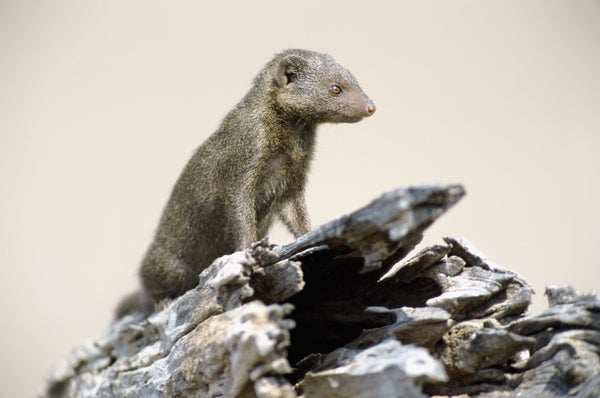

Small, tasty mammals like dwarf mongooses have one main goal: do not get eaten. So the animal—a type of weasel—has a surveillance system. While most of the group focuses on finding food, a handful of others watch for predators. They take turns so that the burden is distributed equally. But in other ways, there’s a definite class distinction.
"You have a typical cooperative breeding society, which you see in a number of different species like meerkats, for example, or African wild dogs. So you have a dominant breeding pair, male and female pair that will reproduce, and they're the only group members that are guaranteed to have offspring."
University of Bristol biologist Julie Kern.
On supporting science journalism
If you're enjoying this article, consider supporting our award-winning journalism by subscribing. By purchasing a subscription you are helping to ensure the future of impactful stories about the discoveries and ideas shaping our world today.
"But then within both sexes there's a linear dominance hierarchy, so if you are quite far down the hierarchy in your own group, it could take quite a long time for you to reach that breeding position, which is what you really want. So it may be best for you to actually leave your group that you were born into and try to join another group where there are fewer same-sex individuals, so you can effectively join a group higher up the queue than the one that you're already in."
When new immigrants shows up, that means more mongooses can act as lookout against predators. Right? In reality, it’s more complicated.
Kern and her team observed seven different groups of wild dwarf mongooses in South Africa. They found that new immigrants rarely served as sentinels. It wasn't until they'd been in their new groups for five months, on average, that they spent as much time working as lookout as the other mongooses did. The study was published in the journal Current Biology. [Julie M. Kern and Andrew N. Radford. Reduced social-information provision by immigrants and use by residents following dispersal.]
Kern thinks that mongooses go through a transition phase before they're fully integrated into the new group. In part, that's because newcomers arrive exhausted and underweight. They need time to recover before becoming fully contributing members of mongoose society.
But the existing group also takes a while before they trust newcomers. In a playback study, the researchers found that mongooses responded far less to the sentinel calls
<
of recent immigrants than to those from others they already knew and trusted. But after a few months spent getting to know their new friends, they began to trust them, and reacted appropriately when hearing the alarm call.
<
"When individuals first join, they don't contribute much to sentinel behavior, and when they do, that information is generally ignored. But within five, six months down the line, then those individuals contribute just as much as everyone else does, and residents value their information just as much as everybody else does."
Ultimately, increased group size really is beneficial to all members of a group—new immigrants just need a chance to get settled.
—Jason G. Goldman
[The above text is a transcript of this podcast.]
