

If I buy you lunch today, chances are you'll pick up the tab next time. We humans reciprocate a lot… days, weeks or even months later. And other primates do it too. Monkeys that are more generous with food, for example, enjoy more grooming from their peers… and they're more likely to get backup later on in a fight.
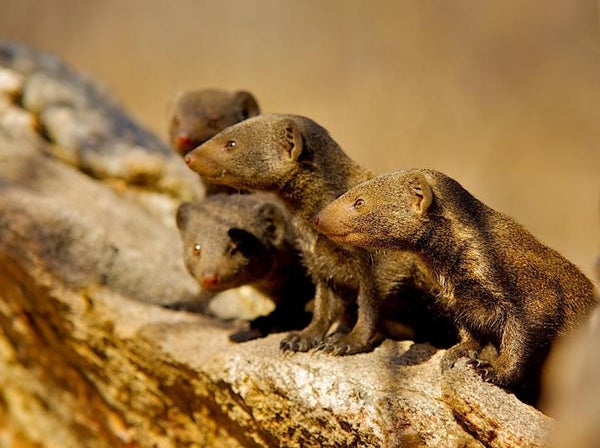
Now a new study suggests a nonprimate, the dwarf mongoose, also makes cooperative, time-delayed barters… trading grooming for guard duty. Here's how it works.
"When an individual is on sentinel, they are basically on guard duty for the rest of the group." Julie Kern, a behavioral ecologist University of Bristol. "So they will choose an elevated position like a tree or a termite mound from which to sit and then they watch out to predators that are coming in to target the group. They'll give alarm calls if they spot these, <
On supporting science journalism
If you're enjoying this article, consider supporting our award-winning journalism by subscribing. By purchasing a subscription you are helping to ensure the future of impactful stories about the discoveries and ideas shaping our world today.
But throughout the watch, they also remind everyone they're on lookout, with softer surveillance calls <
What Kern and her colleagues observed in the wild was that mongooses who took those lookout shifts also enjoyed more grooming back at the burrow. Then, to establish cause and effect, they played recordings of certain mongoose individuals making surveillance calls - in effect tricking the mongoose's peers into thinking it was logging lookout time. And indeed, the supposed sentry was rewarded with more grooming later on… suggesting that dwarf mongooses trade favors, even after time has passed.
The details are in the Proceedings of the National Academy of Sciences. [Julie M. Kern and Andrew N. Radford, Experimental evidence for delayed contingent cooperation among wild dwarf mongooses]
Not to say mongoose society is quite as complex as ours. "I think there are obviously ways in which we track contributions which are very different to what's going on here." But at a very basic level - it appears mongoose society also follows the rule, "You scratch my back, and I'll scratch yours."
—Christopher Intagliata
[The above text is a transcript of this podcast.]
