
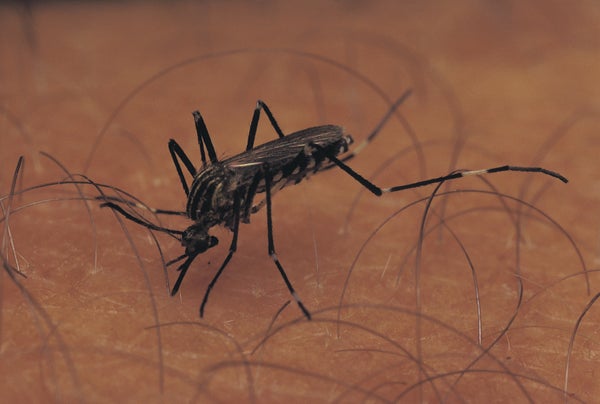

When it comes to sucking blood, mosquitos can play favorites: they show preferences for particular species or even certain individuals. At the same time, their tastes can change, depending on the circumstances. One species of skeeter in California, for example, has a fondness in summer for robins, but will settle for mammals once the birds head south for the winter.
But how do mosquitoes decide what’s on the menu? And when to shift to something new? It appears that they play it by nose—and by their intended victim’s behavior. Because a new study shows that mosquitoes not only memorize the scent of their preferred host, they can use these olfactory cues to avoid individuals who try to swat them. The finding is in the journal Current Biology. [Clément Vinauger et al., Modulation of Host Learning in Aedes aegypti Mosquitoes]
Researchers took female mosquitoes of the species Aedes aegypti and loaded them one by one into a maze shaped like a Y. One arm of the Y was suffused with the scent of a human volunteer. The other contained a control solution of mineral oil. As predicted, the mosquitoes showed an obvious preference for eu d’ Homo sapiens.
On supporting science journalism
If you're enjoying this article, consider supporting our award-winning journalism by subscribing. By purchasing a subscription you are helping to ensure the future of impactful stories about the discoveries and ideas shaping our world today.
Next, the researchers attempted to train the mosquitoes to flee from the heady aroma of humans. So they coupled the exposure to human odor with a mechanical vibration—something akin to the shock that might accompany a near-miss by a swatting host. Sure enough, mosquitoes that were trained to associate human smells with their potentially deadly defensive maneuvers lost their appetite for the previously attractive scent.
That learning, the researchers found, is made possible by the neurotransmitter dopamine. This biological chemical has previously been shown to play a role when female mosquitoes seek someone to suck. And it’s involved in learning and memory in other insects.
So the researchers used an array of molecular techniques to knock out the aegypti’s ability to sense and respond to dopamine. And without this neurotransmitter, mosquitoes become much worse at learning to avoid danger.
Targeting mosquitoes’ smarts could thus provide a new method for curbing the spread of diseases carried by Aedis aegypti—like Zika, dengue, and yellow fever. Because mosquitoes that are slow learners
—Karen Hopkin
[The above text is a transcript of this podcast.]
