
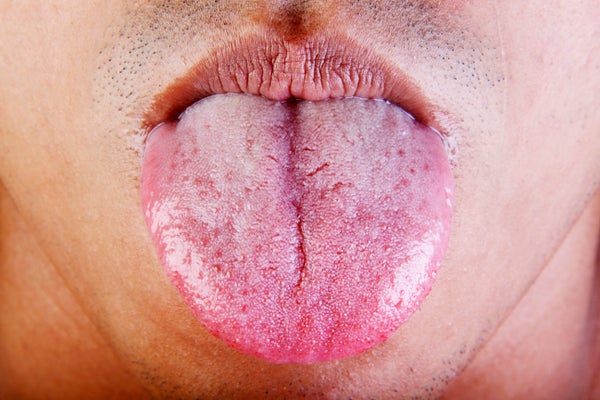

When you burn your tongue or cut your cheek, the pain can be intense. But the wound heals pretty quickly, compared to injuries elsewhere.
That’s because all the factors needed to repair a wound are ready to jump into action in oral tissue—and a new study shows that proteins called transcription factors, which control all those healing elements, are present at greater levels in the mouth.
You can think of those controlling proteins as theater directors…and the healing factors as the actors, waiting in the wings. "They are ready to go, right on the sidelines, in the oral epithelia, so the director says come ahead and then they are just right onstage." Maria Morasso, a senior investigator at the National Institutes of Health.
On supporting science journalism
If you're enjoying this article, consider supporting our award-winning journalism by subscribing. By purchasing a subscription you are helping to ensure the future of impactful stories about the discoveries and ideas shaping our world today.
She says that's not the case in regular skin tissue. "The actors are in their room or in their house. They have the capability of coming on stage. But they're nowhere close, so you have to go through that step of getting them onstage to go ahead with that function."
Which delays healing. "It might be difficult to have the play finish on time and according to the script." The study is in the journal Science Translational Medicine. [Ramiro Iglesias-Bartolome et al., Transcriptional signature primes human oral mucosa for rapid wound healing]
Morasso and her colleagues also tested this idea by genetically engineering mice to have more of those factors, the 'directors', in their regular skin tissue—and sure enough, those mice had significantly faster skin wound healing than did control mice.
But we can't genetically engineer humans. Instead, Morasso says, if we can learn more about who the healing 'actors' are… and perhaps we can find targeted ways of sending those individuals onstage…to deliver a better performance for patients.
—Christopher Intagliata
[The above text is a transcript of this podcast.]
