
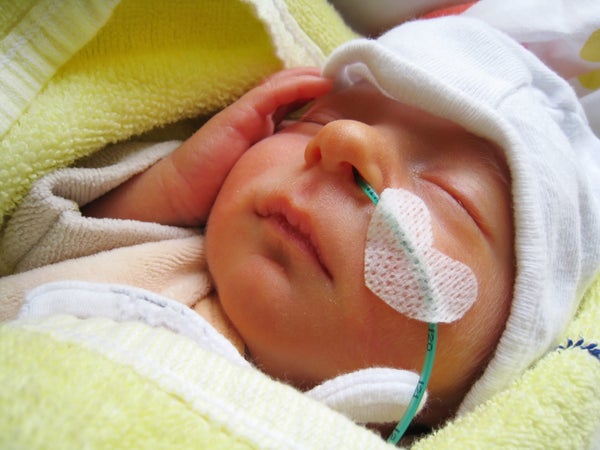

Fifteen million babies are born prematurely every year, worldwide. In some cases, the early births can be life-threatening—or cause developmental issues.
"They have more attention-deficit difficulties. They can have a higher risk of having autism, and in general socio-emotional regulation issues." Petra Hüppi, a pediatrician and neonatologist at the University Hospital of Geneva.
Now, she and her colleagues have evidence that a simple tool could help those preterm babies' brains develop: music.
On supporting science journalism
If you're enjoying this article, consider supporting our award-winning journalism by subscribing. By purchasing a subscription you are helping to ensure the future of impactful stories about the discoveries and ideas shaping our world today.
"When I thought about Mozart, I thought, this is a very complex musical structure and I could hardly imagine that such an immature brain would be able to fully capture the complexity of Mozart."
So instead, she recruited the harpist Andreas Vollenweider, who worked with neonatal nurses to determine which sounds would most stimulate infants' brains. He then composed a suite of three eight-minute-long tracks, which the nurses played to 20 preterm babies using wireless headphones embedded in little baby caps. Each baby heard five tracks a week for six weeks on average.
Then Hüppi's team used MRIs to visualize activity in the babies' brains, and they found that preemies who listened to tunes had brain networks that more closely resembled those of full-term babies compared to their counterparts who didn't get the treatment. The music listeners had greater connectivity among brain regions, such as areas involved in sensory and higher-order cognitive functions—indicating that music listening might have enduring effects on brain development.
The details are in the Proceedings of the National Academy of Sciences. [Lara Lordier et al., Music in premature infants enhances high-level cognitive brain networks]
Of course, many questions still remain. “How much should they listen to that? Was the music given in the right way? Would it be much better if it was something more lively than recorded music? Was it too simple? Could it be more complex?"
But Hüppi said one thing parents can already do is sing to their children. Plus, she said, it doesn't really matter if you can carry a tune.
—Christopher Intagliata
[The above text is a transcript of this podcast.]
