

Rachel Feltman: Happy Monday, listeners. For Scientific American’s Science Quickly, I’m Rachel Feltman. You’re listening to our weekly science news roundup.
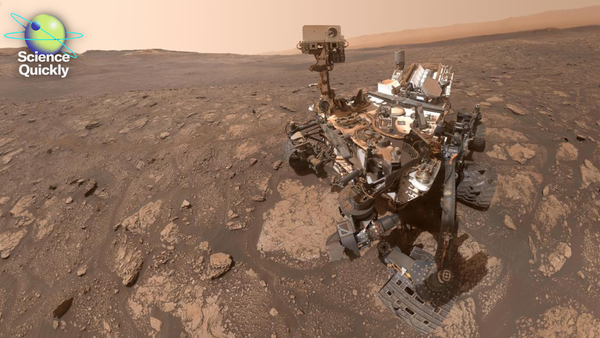
Let’s start on a high note with some space news. NASA’s Curiosity rover has turned up some tantalizing new data adding to the case for life on Mars—or at least offering more hope that we might find some. Basically, regardless of whether the molecules described last Tuesday in a study published in Nature Communications actually came from ancient microbial life, they’re old enough to show that such life, if it ever existed, might have left behind some clues that are still around today.
The new findings come from a bit of rock that Curiosity analyzed way back in 2020. It used its onboard lab equipment to release gaseous molecules from the sample and identify them. Earthbound analyses have now confirmed that the rock, which came from a part of the Martian peak called Mount Sharp that was once covered with water, held 21 different carbon-containing molecules. NASA says that that’s the most diverse collection of Martian organic molecules ever found. In fact, seven of those molecules had never even been detected on Mars before, including nitrogen heterocycles, which are considered to be precursors to RNA and DNA.
On supporting science journalism
If you're enjoying this article, consider supporting our award-winning journalism by subscribing. By purchasing a subscription you are helping to ensure the future of impactful stories about the discoveries and ideas shaping our world today.
Finding organic molecules is promising in and of itself because these represent some of the basic building blocks that make life as we know it possible. Still, they don’t necessarily mean that life did evolve on Mars. But because the bedrock is estimated to date back about 3.5 billion years—which is around when Mars had liquid water on its surface—the fact that Curiosity got any chemistry results at all is very exciting. Given the high levels of radiation on Mars stemming from its thin atmosphere, scientists weren’t actually sure they’d even be able to detect chemical signatures from that ancient window of potential habitability.
Now let’s dig into a study at the intersection of history and health. A paper published last Wednesday in Science Advances suggests that human migration patterns may have gotten a little help from a surprising outside influence: malaria.
It’s becoming increasingly clear that our species emerged—and developed the population structure we see today—thanks to the interaction of lots of different groups of early humans. Shifts in the climate are thought to have shaped much of the migration that fueled those dispersals and interactions, but this new study argues that diseases could have played a similar role in shaping our ancestors’ comings and goings.
Using computer models that tracked the distribution of three major mosquito groups and extrapolating the epidemiological effects, researchers showed that increased malaria transmission risk seemed to correlate with where and when humans made themselves scarce between 74,000 and 5,000 years ago. In other words, for tens of thousands of years, the task of avoiding malaria may have played a big role in where humans lived. It’s possible that other diseases impacted our population dynamics further back in evolutionary history, perhaps even contributing to the interactions between different species of Homo that led to the emergence of modern humans in the first place.
Next, we have some good news on the impact of the 988 Suicide & Crisis Lifeline. In 2022 the U.S. government switched the hotline number from 10 digits to three—just 988—and they invested around $1.6 billion in expanding crisis center support.
[CLIP: An individual speaks in a public-awareness video from the North Carolina Department of Health and Human Services: “Three numbers helped me find the help I needed.”
Another individual speaks: “988 Suicide & Crisis Lifeline, call, text or chat 24/7.”]
A study published in the Journal of the American Medical Association last Wednesday suggests that investment is paying off and could be saving lives.
The researchers looked specifically at adolescents and young adults—people aged 15 to 34. Suicide is one of the leading causes of mortality for these age groups. Previous studies have shown that while overall use of the Crisis Lifeline more than doubled in the three years following the 2022 shift, adolescents and young adults were disproportionately high users of the service.
Based on pre-988 Lifeline trends, the new study reports, the researchers expected to see 39,901 deaths by suicide among this age cohort. Instead they saw fewer than 36,000. They also found that in the 10 states with the largest increase in 988 calls after the launch, the difference between observed and expected deaths by suicide was significantly higher than in states with low 988 usage. To increase their certainty that 988 was making a positive change for young people, the researchers ran the same kinds of analyses on different demographic groups, such as seniors, who are known to be infrequent users of the hotline, and they didn’t have the same gap in projected deaths vs actual deaths. The study authors also analyzed similar data from England, where there hadn’t been any kind of new investment in crisis hotlines, and they failed to find a comparable dip in young people taking their own lives.
While it’s still impossible to know exactly how many lives have been saved specifically because of the big investment in 988, the results are certainly promising—and they’re a reminder of the importance of funding mental health resources. You can call, text or chat online with the 988 Lifeline in English or Spanish 24 hours a day, seven days a week, 365 days a year. You’ll be connected with a counselor who can offer support and suggest resources to help with whatever you’re going through.
Before we get into our last story, I have to ask: Can you hear me now? If I sound a little—off, that’s because this isn’t really the Rachel you know and love. It’s a voice clone: a synthetic voice made to sound like Rachel using AI. Unlike more old-school synthetic voices like Siri, which relied on hours and hours of voice recordings to string together coherent speech, today’s voice clones only need a few seconds of audio to mimic you.
Hey, it’s the real Rachel again. I’m not too worried about that robot taking my job, but a study published last week in the Journal of the Acoustical Society of America found that voice clones might beat human speakers on one metric: intelligibility. While the researchers expected machine-replicated speech to be difficult for people to understand—at least compared with the real thing—they actually found that clones consistently got higher scores than humans in that regard. The researchers’ next step is to try to figure out why because they’re really not sure. In the meantime, how do you think my voice clone measured up? You can let us know at sciencequickly@sciam.com, and remember, you can always use that e-mail address to send us any comments or questions.
That’s all for this week’s science news roundup. We’ll be back on Wednesday to take you to the very edge of spacetime.
Science Quickly is produced by me, Rachel Feltman, along with Fonda Mwangi, Sushmita Pathak and Jeff DelViscio. This episode was edited by Alex Sugiura. Shayna Posses and Aaron Shattuck fact-check our show. Our theme music was composed by Dominic Smith. Subscribe to Scientific American for more up-to-date and in-depth science news.
For Scientific American, this is Rachel Feltman. Have a great week!
