
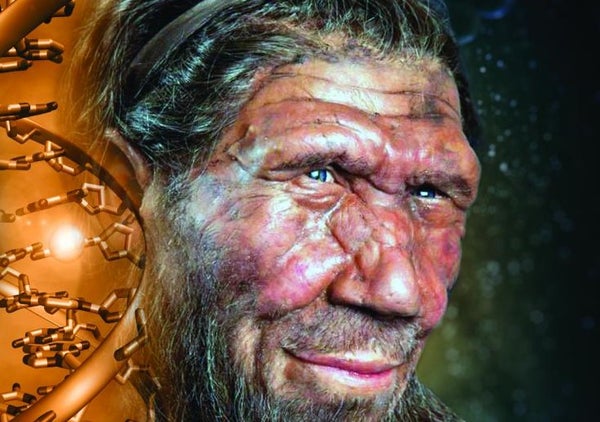

Neandertal walks into a bar. Bartender says, “Why the long, forward-projecting face?” Well, according to a new study, it helped the Neandertal air-condition the large volumes of oxygen he inhaled to support his active lifestyle. The work appears in the Proceedings of the Royal Society B. The bartender appears in many, many jokes. [Stephen Wroe et al., Computer simulations show that Neanderthal facial morphology represents adaptation to cold and high energy demands, but not heavy biting]
Neandertals had a distinct facial appearance: heavy brows, big noses and a protruding upper jaw. And scientists have long wondered why that configuration. The foreheads, it appears, they inherited from their ancestors. But the jutting midface—that was an evolutionary innovation all their own.
Some scientists say it’s so they could use those prominent front teeth for some serious chomping. Others say it gave their nasal passages the right size and shape to warm and moisten the cold, dry, Ice Age air.
On supporting science journalism
If you're enjoying this article, consider supporting our award-winning journalism by subscribing. By purchasing a subscription you are helping to ensure the future of impactful stories about the discoveries and ideas shaping our world today.
To put the theories to the test, researchers constructed a set of 3-D simulations of the skulls of various humans. They included a Neandertal and an earlier Homo heidelbergensis as well as a handful of more modern noggins: males and females from Europe and Asia and an Arctic Inuit. And they digitally crash-tested the faces to see how they responded to the loads imposed by heavy biting.
Seems the protruding choppers of the Neandertal were not particularly well suited to forceful mastication. Some of the modern humans seemed to be more efficient when it comes to using less muscle to take a big bite.
Then the researchers modeled how air flowed through Neandertal nasal passages. And that’s when things got interesting. The results indicate that Neandertals were better at heating and humidifying air than H. heidelbergensis. But so are us modern peoples—whether we hail from cold or hot climates.
Where Neandertals really stood out was in their ability to move large volumes of air through their nasal passages in and out of their lungs. That’s a plus when you spend your days running down mastodons. Or running from other critters whose teeth are better adapted for biting action than yours are.
So if the bartender is still listening, that's why the distinctive Neandertal face.
—Karen Hopkin
[The above text is a transcript of this podcast.]
