
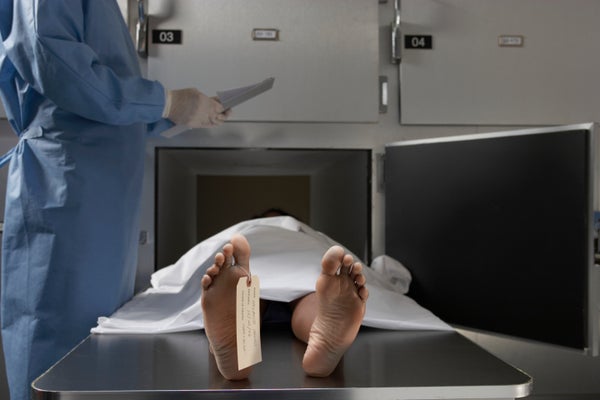

Tens of trillions of microbes call our living bodies home. But when we die? "The first thing that happens is basically ecosystem collapse—where you have a tremendous loss of diversity." Nathan Lents, a molecular biologist at John Jay College in New York. "And then it bottoms out and starts to get rich again."
That microbial phoenix, rising from our extinguished mortal coils, is called the "necrobiome." Lents and his team tracked the necrobiome, by swabbing the ears and noses of 21 cadavers at a body farm in Tennessee. It's a sort of outdoor lab for forensic scientists, where bodies are left to the elements to decompose.
They tracked the genetic signatures of that microbial community as it waned and waxed after death. And they used that data to build an algorithm that could pinpoint a corpse's time of death, to an accuracy of just two summertime days. "And that held out for up to six to seven weeks. And that's way better than entomology can tell you." Entomology being the study of the insects that colonize a corpse. "Entomology's okay for giving you upper and lower limits within five to seven days, but beyond that, entomology's not helpful."
On supporting science journalism
If you're enjoying this article, consider supporting our award-winning journalism by subscribing. By purchasing a subscription you are helping to ensure the future of impactful stories about the discoveries and ideas shaping our world today.
The study is in the journal PLoS ONE. [Hunter R. Johnson et al., A Machine Learning Approach for Using the Postmortem Skin Microbiome to Estimate the Postmortem Interval]
The method isn't quite ready for primetime. There's still a lot of 'biological noise' in the system. "We're talking about living things here. Well... living and dead things." But as with any machine learning, more info will help it see beyond the noise. "It will forever learn. So the more data we pump into this system, the better it will get." Ultimately, Lents says, the algorithm will have to be smart enough to hold up in a court of law, when it could determine the fate of someone accused of turning someone into a corpse.
—Christopher Intagliata
[The above text is a transcript of this podcast.]
