

Sarah Vitak: This is Scientific American’s 60-Second Science. I’m Sarah Vitak.
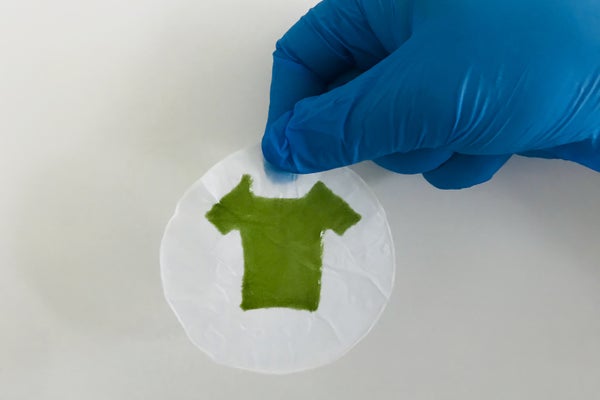
What if you could create household objects—maybe bio-garments, kitchen appliances, or blinds and curtains—that powered themselves using the sun, were fully recyclable, 100 percent biodegradable, sequestered carbon just by existing, filtered toxins out of the air and were also—alive? Dr. Marie Aubin-Tam at Delft University and a postdoc researcher in her lab, Srikkanth Balasubramanian, have gotten one step closer to making that a reality. They have created a 3-D-printed photosynthetic material using algae.
Here is Dr. Aubin-Tam.
On supporting science journalism
If you're enjoying this article, consider supporting our award-winning journalism by subscribing. By purchasing a subscription you are helping to ensure the future of impactful stories about the discoveries and ideas shaping our world today.
Marie Aubin-Tam: We were interested in 3-D printing living material that’s made of microalgae. And there were a couple examples of 3-D-printed algae material already out there, but we were interested in making one that will be enough mechanically robust to be used in real applications because a lot of these materials are based on hydrogels, which tend to be very fragile.
Vitak: You might not have heard of hydrogels, but you’ve certainly used them. Wet, disposable baby diapers, chia pudding, toy water beads: all of these are hydrogels you might have around your house. But hydrogels aren’t very strong or solid, so the team wanted to make something better.
They already had a 3-D printer that they had built in their lab to print materials with bacterial bioink—a solution that contains living cells that you load in a 3-D printer.
Aubin-Tam: We were also studying the microalgae Chlamydomonas reinhardtii but for a different purpose. We’re interested in the physics of how it swims and how it moves the flow around itself when it swims.
Vitak: They had the idea that maybe they could put the two together. They created a bioink out of the living microalgae and printed it onto bacterial cellulose—a fibrous material that can be produced by bacteria. It grows as a rubbery film on top of bacterial cultures, but when it’s dried out, it is like a tough paper.
The clever part of their method is that the algae bioink won’t solidify until it comes into contact with calcium chloride. So they put it in agar on a petri dish, then place the bacterial paper above and print on that. When the algae ink is printed on top of the paper, it comes into contact with the calcium that is diffusing through and solidifies.
Aubin-Tam: It almost immediately, I think the first trial, it immediately worked. So we thought that it was very promising. And then, yeah, we tried different conditions, different designs. And then we test the mechanical properties of this material.
Vitak: The bacterial paper stays on the print like a backing and provides the material with more strength than hydrogel prints alone. It can handle twisting and crushing. The material can survive three days on its own and at least a month (probably longer) if fed with nutrients every couple days. It can be kept in light or dark. And it can easily be dissolved, and the algae can be removed and placed right back in the printer to make more material. And, of course, the material can also be dissolved and then is fully biodegradable.
The printed material won’t grow noticeably in volume over time, but the number of cells increase and so does the amount of chlorophyll. Best of all, this process is relatively inexpensive. Here is Dr. Balasubramanian.
Srikkanth Balasubramanian: And one biggest advantage of our approach with a 3-D printer is that it is really cost-effective because if you consider 3-D printers that are already available in the market that can print living cells, they are like they are in the price range of thousands to hundreds of thousands of dollars, but our 3-D printer is just like less than $250. So this is a do-it-yourself 3-D printer. So anybody who can actually do this printing at home.
Vitak: And, in fact, all the instructions for printing are available in their paper, published in the journal Advanced Functional Materials. [Srikkanth Balasubramanian et al., Bioprinting of regenerative photosynthetic living materials]
A previous paper from the group has all the details of how to build the printer. So you really could do it at home.
Ultimately, the possibilities with this kind of material are many. From creating synthetic leaves to producing oxygen for life in outer space to filtering contaminants out of air and water to photosynthetic textiles. But those applications are all still a little ways in the future.
The team’s proof-of-concept prints were relatively flat—about 10 to 20 layers high. So their next big hurdle is getting height.
Aubin-Tam: That’s one of the limitation with our current approach—is that in order for the hydrogel to solidify, there needs to be some calcium that diffuses all the way into the print. So that limits the the height that we can achieve right now.
Vitak: But they are already well underway in taking their material to new heights. And some of their prints have been shipped to a few people’s homes—a kind of living material live test. So sun-powered blinds or an apron that sequesters carbon might be a reality sooner than you think.
Thanks for listening. For Scientific American’s 60-Second Science, I’m Sarah Vitak.
[The above text is a transcript of this podcast.]
