
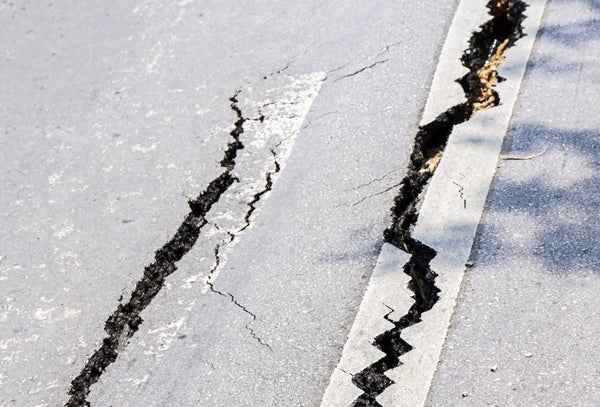

There's a stretch of highway in Pennsylvania, along U.S. 422. "And like every probably 20 feet you see a big pothole or cracking at the joint. Like everywhere. It was so bad." Yaghoob Farnam is a construction materials engineer at Drexel University in Philly. And this road is pretty much his worst nightmare. "Yeah and just imagine I was driving like 60 miles per hour, I could see, I could feel it, I was driving, I was so mad, like, 'what is going on with this?'"
The culprit, he says, may be calcium chloride road salt, used to de-ice highways in the winter. Because calcium chloride reacts with a compound in concrete called calcium hydroxide to form something called calcium oxychloride. "It's a huge molecule that causes a lot of pressure inside concrete. And starts degradation of concrete."
The solution? Novel blends of concrete that use cheap leftover materials from the coal and steel industries: fly ash, silica fume and slag. In his latest work, Farnam and his team created plugs of these experimental concretes, and submerged them in salty solutions—along with plugs of conventional concrete. Then they eavesdropped on any cracking with high-sensitivity acoustic sensors. And they tracked heat flow through the material, to monitor chemical reactions.
On supporting science journalism
If you're enjoying this article, consider supporting our award-winning journalism by subscribing. By purchasing a subscription you are helping to ensure the future of impactful stories about the discoveries and ideas shaping our world today.
The results: concrete slugs made with ingredients like fly ash and slag held up remarkably well after more than a month. Whereas normal concrete was cracked to pieces in just a week. Their recipes are in the journal Cement and Concrete Composites. [Yaghoob Farnam et al., Evaluating the use of supplementary cementitious materials to mitigate damage in cementitious materials exposed to calcium chloride deicing salt]
Farnam says some states have actually started using this sort of concrete—because it's already known to make the material more durable against other factors, like corrosion of internal steel reinforcement. As for those cracks on U.S. 422, and elsewhere? Farnam has another project in the works—to apply a bacterial slurry, which forms limestone when it interacts with salt, plugging up the gaps. But
he says that work is still a ways…down the road.
—Christopher Intagliata
[The above text is a transcript of this podcast.]
