
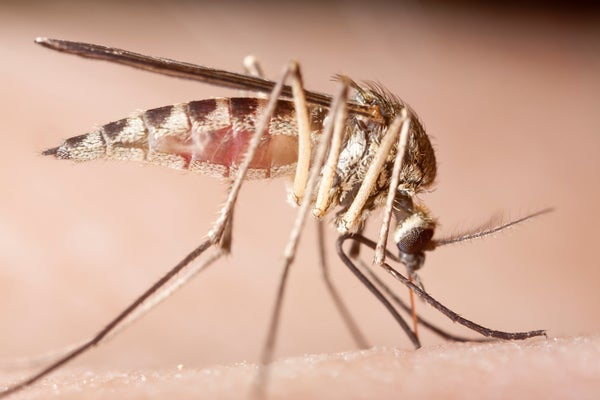

It's bad enough that mosquitoes suck our blood, and sometimes pass on disease. But there's more. "They can actually give you a disease and pee on you at the same time. Adding insult to injury if you will." Jerod Denton, a pharmacologist at Vanderbilt University Medical Center.
"If you look up almost any picture on Google of a mosquito taking a blood meal you'll see a clear drop of fluid hanging out of the rear end of the mosquito. That's actually the urine the mosquito has made from your blood."
That pee production is vital to the mosquito's survival. Because blood is salty. "And as these mosquitoes digest the red blood cells to get at the proteins and other nutrients hiding there, they release potassium chloride which can cause depolarization of the membrane potential of excitable cells and induce ‘excitotoxic death.’" Translation: not good. So mosquitoes and other bloodsuckers have evolved a rapid diuretic process to expel salt from their bodies, using kidney-like structures. Basically, while still sucking blood, they start peeing.
On supporting science journalism
If you're enjoying this article, consider supporting our award-winning journalism by subscribing. By purchasing a subscription you are helping to ensure the future of impactful stories about the discoveries and ideas shaping our world today.
But Denton and his colleagues found a way to block all that. They developed a chemical compound that blocks the bugs' salt-ejecting pores, "sort of like a cork in a bottle." So when the skeeters come in contact with the compound, they swell up—and stay that way. "And in some cases we can actually see the abdomen rupture, because they've basically overfilled with food." The study is in the journal Scientific Reports. [Daniel R. Swale et al., An insecticide resistance-breaking mosquitocide targeting inward rectifier potassium channels in vectors of Zika virus and malaria]
The substance doesn't kill honeybees, and it works well on insecticide-resistant mosquitoes, too. So if it turns out to be safe enough to use around humans, the pesticide will give a whole new meaning to "bye-bye, sucker!”
—Christopher Intagliata
[The above text is a transcript of this podcast.]
