
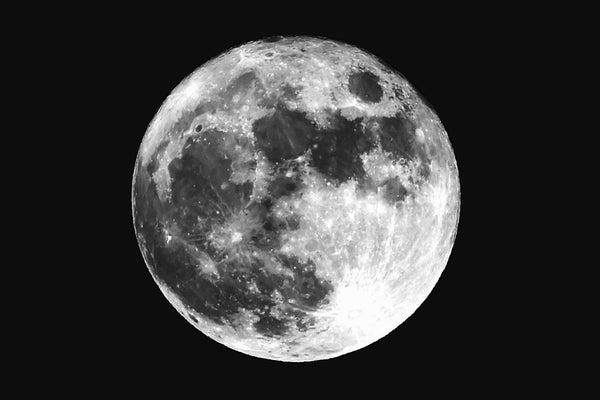

On July 20th, 1969, humankind finally set foot on the surface of the moon. Fifty years later a big mystery remains: how the heck the moon got there in the first place.
For decades, the thinking has been that four and a half billion years ago a Mars-sized protoplanet smashed into the Earth. When the dust settled, our moon remained, forged from the debris of Earth and the other object.
Problem is, as scientists have taken more and more precise isotopic measurements of the Moon they've found that it's nearly identical in composition to the Earth—not some other object.
On supporting science journalism
If you're enjoying this article, consider supporting our award-winning journalism by subscribing. By purchasing a subscription you are helping to ensure the future of impactful stories about the discoveries and ideas shaping our world today.
"A problem I've been advertising as an isotopic crisis." Jay Melosh studies planetary impacts at Purdue University. Now, he says, a new theory in the journal Nature Geoscience may at least point to a way out of that isotopic crisis of the moon’s chemical isotopes so closely resembling Earth’s. [Natsuki Hosono et al., Terrestrial magma ocean origin of the Moon]
Here's the idea. The authors, a team of Japanese scientists, write that maybe in those early days of the solar system the Earth was sloshing with oceans of magma. Then, when the Mars-sized object slammed into those molten seas, their models predict a lot more Earth-derived material got ejected into orbit in the form of scorching vapors.
"Temperatures of tens of thousands of degrees. And so that expands at speeds that exceed the escape velocity of the earth, and in that way it injects material into orbit around the Earth."
That material rapidly coalesces, and bingo, you've got a moon. Melosh says there are still a few kinks to work out in the scenario. Still, he says, it's a step forward.
"Think of it as a major clue in a murder mystery or something like that. It could be a true clue toward the answer or it could be a deception—we don't know yet." So it could be that when astronauts started walking on the moon a half-century ago, they were really leaving footprints on the remains of the primordial Earth.
—Christopher Intagliata
[The above text is a transcript of this podcast.]
