

You wouldn't think studying lizards is a particularly dangerous profession. Until, that is, sheriffs approach you with their guns drawn. "We get the cops called on us sometimes."
Bree Putman, a behavioral ecologist at U.C.L.A. and the Natural History Museum of Los Angeles. Her colleague at the museum, Greg Pauly, really did end up on the wrong side of a gun once, and here's why:
"A lot of times we're doing work at night in people's neighborhoods and we're using flashlights to look for geckos on the sides of people's houses. And so sometimes people will think we're criminals or burglars or something."
On supporting science journalism
If you're enjoying this article, consider supporting our award-winning journalism by subscribing. By purchasing a subscription you are helping to ensure the future of impactful stories about the discoveries and ideas shaping our world today.
The museum's solution was neon orange shirts with the museum logo. "And we call these shirts the ‘don't shoot me’ shirts." But the bright orange left Putman with a concern: that the color would spook the very animals they were trying to study.
So she devised an experiment. "I basically designed a study to show to the museum staff that these shirts were not going to be good for research, and that's what I found.”
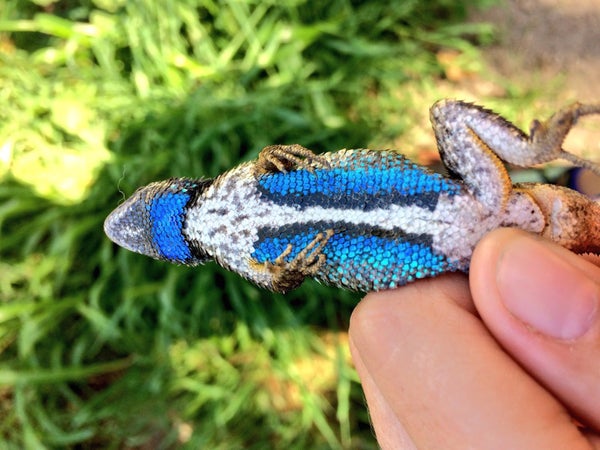
In her trials, Putman wore tank tops of various colors—red, gray, light blue, dark blue—and then attempted to approach and capture western fence lizards in public and private parkland in L.A. And she found that when wearing dark blue, she could get twice as close to the lizards, compared to when she wore red. And she was about twice as likely to catch a lizard too, while wearing dark or light blue, compared to red or gray. The study appears in the journal PLOS ONE. [Breanna J. Putman et al., Fear no colors? Observer clothing color influences lizard escape behavior]
Putman thinks that the lizards may be more tolerant of blue hues, because they most closely resemble the blue patches males have on their bellies—a sexual signal. Other studies have shown that birds with orange and red plumage are similarly less creeped out by orange and red shirts. She's not ready to issue a dress code to hikers just yet, but:
"You know for a scientist or biologist working with wild animals, you want to make sure either that you're wearing the same outfit every time you're going to do animal behavior. Or you want to randomize what you wear."
As for those museum shirts, "I actually wear the orange shirt. I don't wear a blue shirt." Because studying wildlife in urban areas, you never know when you might encounter that other species: gun-toting Homo sapiens.
—Christopher Intagliata
[The above text is a transcript of this podcast.]
