
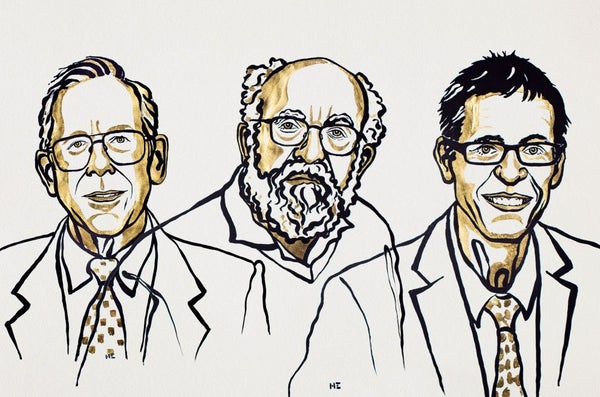

“This year’s Nobel laureates in physics have painted a picture of a universe far stranger and more wonderful than we ever could have imagined.”
Theoretical physicist Ulf Danielsson from Uppsala University. Here’s the announcement this morning from Göran Hansson of the Nobel Assembly at the Karolinska Institute.
“The Royal Swedish Academy of Sciences has today decided to award the 2019 Nobel Prize in Physics with one half to James Peebles for theoretical discoveries in physical cosmology and the other half, jointly, to Michel Mayor and Didier Queloz for the discovery of an exoplanet orbiting a solar-type star.
On supporting science journalism
If you're enjoying this article, consider supporting our award-winning journalism by subscribing. By purchasing a subscription you are helping to ensure the future of impactful stories about the discoveries and ideas shaping our world today.
“James Peebles was born in 1935 in Canada, in Manitoba. And he has had his career largely at Princeton University.... Michel Mayor was born in 1942 in Lausanne in Switzerland. He is emeritus professor of astronomy at the University of Geneva ... in Switzerland. Didier Queloz, finally, was born in 1966, and is also from Switzerland. He is currently professor or astrophysics both at the University of Geneva and at the Cavendish Laboratory of the University of Cambridge in the United Kingdom.”
Back to Ulf Danielsson.
“At the time of its discovery in the mid-1960s, James Peebles realized the importance of cosmic radiation. Through his work and new ways to observe and measure our universe, cosmology evolved into a science of precision, based on the mathematical foundation.
“Michel Mayor and Didier Queloz—they are awarded the Nobel Prize in Physics for the discovery of a planet in orbit around another sun. They couldn’t see the planet directly, so they had to use other methods. When a planet is orbiting a star, the star wobbles back and forth. The effect is tiny, and you need care and ingenuity if you want to detect it. Through the study of these exoplanets, we will learn more about the physics of how planets form and evolve and get a new perspective on our planetary home.”
For an in-depth listen about the 2019 Nobel Prize in Physics, look for the Scientific American Science Talk podcast later today.
—Steve Mirsky
[The above text is a transcript of this podcast.]
