

“I’m an engineer, trained as an engineer. I have degrees in mechanical and chemical engineering, and some people claim that I practice chemistry without a license.”
Frances Arnold. The Caltech scientist shared the 2018 Nobel Prize in Chemistry.
“But what I care about is how do we share the planet with all the other living things and have a planet that’s worth living in, while we cure disease and make our quality of life better?”
On supporting science journalism
If you're enjoying this article, consider supporting our award-winning journalism by subscribing. By purchasing a subscription you are helping to ensure the future of impactful stories about the discoveries and ideas shaping our world today.
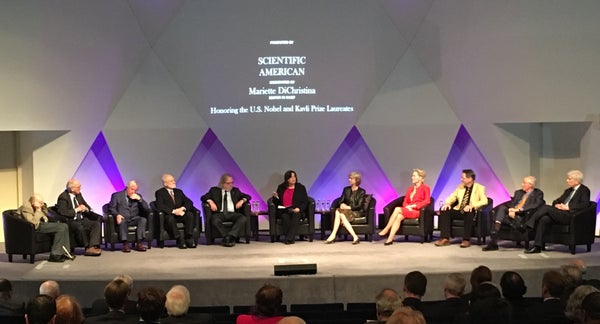
Arnold spoke April 9th at the National Academy of Sciences in Washington, D.C., at an event honoring 10 U.S. Nobel and Kavli Prize laureates. The evening was sponsored by the Kavli Foundation and produced by Scientific American. Arnold’s Nobel Prize was for directing the evolution of enzymes to make them work even better or in entirely new ways.
“And it seems to me that this tremendously powerful algorithm of evolution that ... create complexity and create all of the lovely things in the biological world, we should learn how to use that algorithm to solve the biggest problems that we face. How do we house, fuel, feed, clothe 10 billion people? And it’s the biological world that can do this because we’re learning how to harness this 4 billion years worth of work....
“The problem is no one knows how a sequence of DNA encodes a function ... we can only read it. No one can compose that. But we have the process of composing it, and that is called evolution. And by using that process we can make these things that will help us live sustainably.
“Because who knows how to use renewable resources? The biological world does. Biology can take carbon dioxide from the environment and create living plants, and nitrogen and simple starting materials, and create complicated useful things. So I’m hoping that we too will learn how to do that and use our science to do that.”
—Steve Mirsky
(The above text is a transcript of this podcast)
