
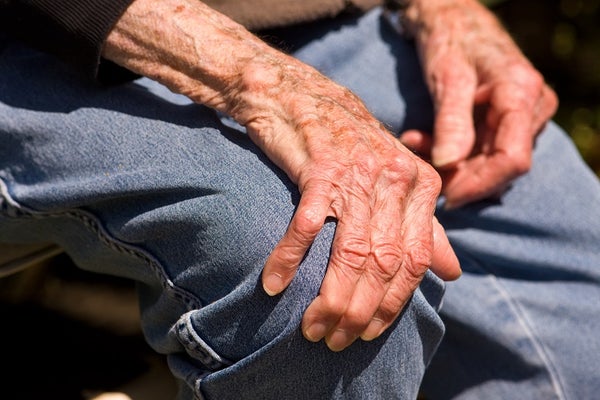

Are you one of those people who can tell when a storm is approaching based on your achy knees? Well, you may think you are. But a new study of more than 1.5 million seniors finds no relationship between rainfall and doctor visits for pain. The results are in the British Medical Journal. [Anupam B. Jena et al., Association between rainfall and diagnoses of joint or back pain: retrospective claims analysis]
The idea that our bodies are barometers for all sorts of weather-related phenomena—including changes in temperature, pressure and precipitation—is not a new one.
“Hippocrates himself actually postulated this idea in nearly 400 B.C.” Anupam Jena, a physician and expert in health care policy at Harvard Medical School and the Massachusetts General Hospital, who led the study.
On supporting science journalism
If you're enjoying this article, consider supporting our award-winning journalism by subscribing. By purchasing a subscription you are helping to ensure the future of impactful stories about the discoveries and ideas shaping our world today.
“If you talk to people, I’d say millions and millions of people probably believe that things like rainfall influence symptoms of joint pain and stiffness. But if you look at the studies, there’s actually been surprisingly little evidence to suggest that is true. Most of the studies have been quite small. And we were interested in thinking about whether we could approach this question in a ‘big data’ sort of way.”
He and his colleagues looked at information collected in more than 11 million visits that older Americans made to their primary care physicians. They compared these records with data on daily rainfall. And they asked: do more people report sore backs or swollen joints when the weather is inclement?
“And what we found is if you look at days where it rained versus days where it didn’t rain, there is no difference in the proportion of visits to a doctor that involved a complaint of joint pain or back pain.”
They saw no “rain effect” even when it poured for seven days straight. And if you’re thinking, well, what if people couldn’t get an appointment until the skies cleared up…
“And if you look the week after a period of heavy rainfall, you still see no relationship. And that doesn’t mean that factors like rainfall or temperature or humidity don’t affect joint pain and symptoms of joint achiness and stiffness. But in this sort of big data approach, we didn’t find any evidence for it.”
Of course, it could still be that the pain from rain is not enough to complain. “It could be that patients take over-the-counter pain medications once these symptoms hit, and so when they see their doctor they’re not actually in enough pain to mention it.” And the casualties of low-pressure fronts simply move on—gingerly.
—Karen Hopkin
[The above text is a transcript of this podcast.]
