
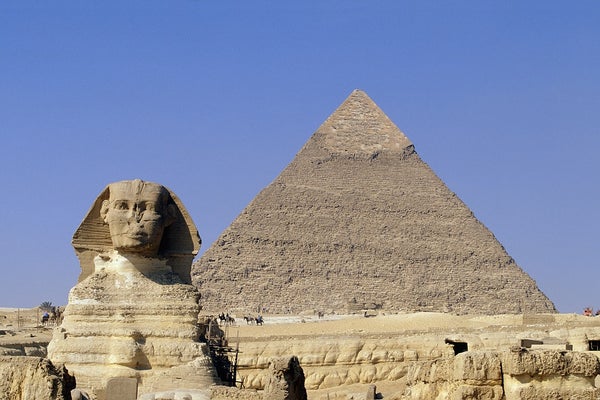

For 4,500 years, the Great Pyramid, or Khufu's Pyramid, has kept watch over the Egyptian desert. In that time, it's suffered the indignities of tomb raiders and gunpowder-toting archaeologists, a la Indiana Jones. But the latest investigation of the pyramid's mysteries is far more sophisticated—and takes a page from particle physics.
Scientists used muons, a by-product of the cosmic rays constantly raining down on our planet, to image the interior of the pyramid. The particles interact differently with stone than with empty space—and that fact led the scientists to discover a previously unknown 100-foot-long void, sitting somewhere above the pyramid's Grand Gallery.
“The good news is the void is there, the other good news is that this void is very big. Now what is it? We need the help of other people.” Mehdi Tayoubi, of the Heritage Innovation Preservation Institute, and an author of a paper detailing the findings in the journal Nature. [Kunihiro Morishima et al., Discovery of a big void in Khufu’s Pyramid by observation of cosmic-ray muons]
On supporting science journalism
If you're enjoying this article, consider supporting our award-winning journalism by subscribing. By purchasing a subscription you are helping to ensure the future of impactful stories about the discoveries and ideas shaping our world today.
"Maybe Egyptologists and specialists in ancient Egyptian architecture will provide us with some hypotheses we can use for simulation and to compare with the data we have to find some sort of architectural explanation for this void."
Until then—the newly discovered space will be just one of many enduring mysteries of this very old wonder of the world.
—Christopher Intagliata
[The above text is a transcript of this podcast.]
