

Musicians are said to have better language skills. And scientific studies have backed that up. But it's not clear why that might be the case.
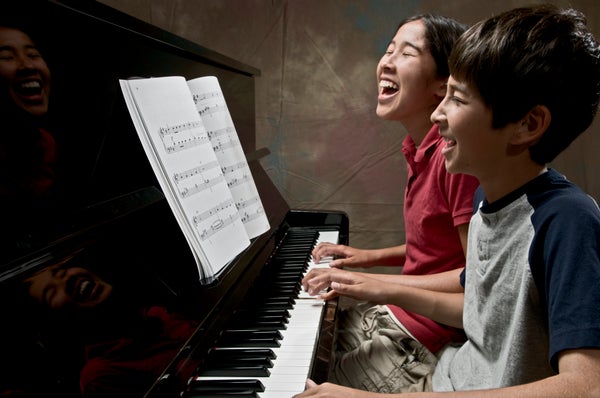
Now a study of 74 Chinese kindergartners suggests six months of piano lessons can heighten the brain's response to changes in pitch. And kids who got piano lessons were also better at telling apart two similar-sounding Mandarin words, which contained different consonants, than were students who got extra reading training, or who went through regular kindergarten.
The results are in the Proceedings of the National Academy of Sciences. [Yun Nan et al., Piano training enhances the neural processing of pitch and improves speech perception in Mandarin-speaking children]
On supporting science journalism
If you're enjoying this article, consider supporting our award-winning journalism by subscribing. By purchasing a subscription you are helping to ensure the future of impactful stories about the discoveries and ideas shaping our world today.
Now Mandarin is a tonal language—the famous example is the word 'ma' which can mean mother or horse depending on its pitch. So might musical training translate better to Mandarin, than, say, English?
"Yeah it's possible that influenced the results." Robert Desimone, a neuroscientist at the McGovern Institute at MIT. But he says other studies do back up the fact that music lessons benefit language learners, even in countries without tonal languages. "And what our study added on top of that was some idea of the neural basis for those benefits."
And if you don't own a piano, don't despair. The reading group actually did just as good on many measures as the piano group. "Reading's pretty good actually. We don't mean to downplay reading instruction."
More important, he says, was to show piano wasn't worse than reading for these skills… perhaps encouraging cash-strapped schools to keep their music programs alive.
—Christopher Intagliata
[The above text is a transcript of this podcast.]
[Rhapsody No. 2 in G Minor–Brahms Licensed under Creative Commons: By Attribution 3.0]

