
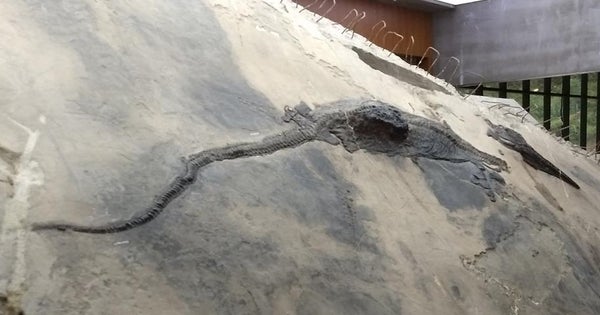

Hundreds of millions of years ago, reptilian predators called ichthyosaurs swam the seas. Their fossils look fearsome. But paleobiologist Ryosuke Motani of U.C. Davis says they may have looked more like friendly dolphins.
“Maybe in life ichthyosaurs would have been cute—at least the smaller ones.”
Motani’s team studied one such specimen found in southwest China. It was 240 million years old—15 feet long. But it seemed to have some extra bones in it—which Motani's team determined to be the remains of a 13-foot-long thalattosaur, or “sea lizard,” the ichthyosaur had swallowed.
On supporting science journalism
If you're enjoying this article, consider supporting our award-winning journalism by subscribing. By purchasing a subscription you are helping to ensure the future of impactful stories about the discoveries and ideas shaping our world today.
And, spoiler alert, the only reason they were able to see this animal in the belly of the ichthyosaur is that this gigantic meal never got digested. The ichthyosaur died soon after swallowing it.
Motani was careful to say they’re not sure exactly why the ichthyosaur perished. But the specimen has a broken neck. So he gave a speculative play-by-play. Perhaps the ichthyosaur snapped at the sea lizard, but the lizard fought back.
“And this fight between the two was fierce, probably.”
So the ichthyosaur fought to subdue its prey, damaging its neck in the process. Then it had to dislodge the prey’s bony head and tail from its juicy midsection.
“Now the predator had to do it through jerking and twisting like crocodiles do.”
Also bad for the neck. And finally, the ichthyosaur had to swallow the animal—perhaps using inertia or gravity to shove the prey down its gullet.
“And the chances are, by the time it was ingested, maybe the neck damage had accumulated to a certain level and maybe the neck could not support the head of the predator that well.”
Details of that ancient battle appear in the journal iScience. [Da-Yong Jiang et al., Evidence supporting predation of 4-m marine reptile by Triassic megapredator]
The reason this analysis matters is you can only infer so much about who ate who by looking at teeth. This fossil offers direct evidence that these ancient beasts sometimes bit off a whole lot more than they could chew.
—Christopher Intagliata
[The above text is a transcript of this podcast.]
