

North Korea has promised to close its underground nuclear test site at Mount Mantap later this month. Shortly thereafter, President Trump is set to meet North Korea's leader Kim Jong-un in Singapore.
Regardless of how that goes, there’s a now an additional tool to investigate covert subterranean tests: radar. Specifically, a type called synthetic aperture radar, which works day and night, and through clouds.
Scientists already use seismic data in their nuclear detective work. "We use the kind of techniques that earthquake seismologists use to figure some aspect of what that explosion did." Roland Bürgmann, a geophysicist at University of California, Berkeley. He says they can also measure isotopes in the air, as well as optical images pre- and post-explosion.
On supporting science journalism
If you're enjoying this article, consider supporting our award-winning journalism by subscribing. By purchasing a subscription you are helping to ensure the future of impactful stories about the discoveries and ideas shaping our world today.
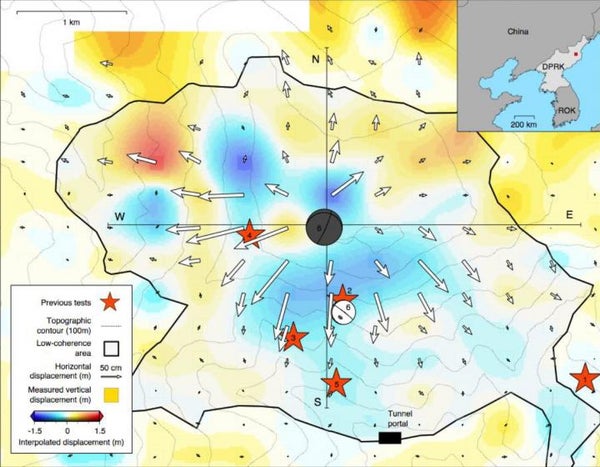
Now Bürgmann and his team have used synthetic aperture radar data from German and Japanese satellites to gather more clues about North Korea's biggest blast, in September 2017. Comparing before and after scans of the test site, their analysis found that the mountain bulged a dozen feet in one direction, and sunk a foot and a half.
Using computational modeling, they then simulated what sort of blasts could have produced those movements. Their estimate: the blast was at least six times as strong as the bomb the U.S. dropped on Nagasaki in World War II. The details are in the journal Science. [Teng Wang et al., The rise, collapse, and compaction of Mt. Mantap from the 3 September 2017 North Korean nuclear test]
"I think our study shows this is an especially valuable observation that can be thrown into the mix." When the U.S. and India launch their synthetic aperture radar satellite, called NISAR, in 2020, we'll have even more of this new kind of data. The hope is that no unauthorized nuclear tests will take place to be discovered.
—Christopher Intagliata
[The above text is a transcript of this podcast.]
