
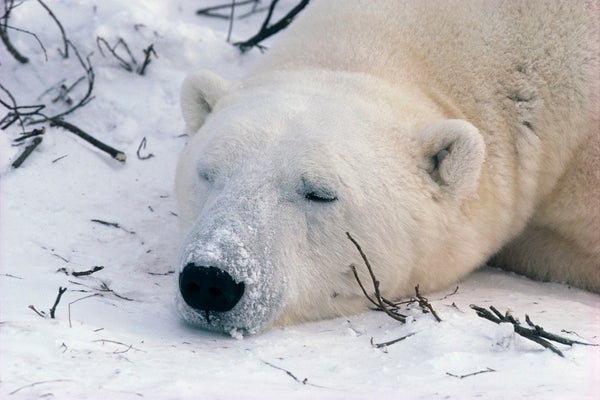

As climate change warms the Arctic, sea ice there is disappearing at record rates—sea ice that polar bears prefer to prowl. As a result, some bears are spending more time on solid land. And are thus switching up their diets, too. Instead of the ringed seals they ate out on the ice, the bears are foraging on bowhead whale carcasses, cast up on the beach.
So what does this mean for them?
"It's sort of good news/bad news." Melissa McKinney, an ecotoxicologist at the University of Connecticut. The bad news is that the bears are losing vital habitat. But the silver lining is that bears decamping to land have lower levels of toxic mercury due to their changes in diet.
On supporting science journalism
If you're enjoying this article, consider supporting our award-winning journalism by subscribing. By purchasing a subscription you are helping to ensure the future of impactful stories about the discoveries and ideas shaping our world today.
McKinney and her team studied hair samples from one polar bear population in Alaska, from 2004 to 2011. In that time they saw a 65 percent drop in the bears' mercury levels—to concentrations below the known threshold for negative biological effects. And it looks like the different diet may be the reason.
Bowhead whales feed on plankton, while ringed seals eat fish and other animals in which mercury has had the chance to accumulate. "So if polar bears are feeding on prey items that are lower in the food chain, then they're likely experiencing a less mercury-contaminated food source than they would be otherwise."
The bears that feed on whales are also in better condition—higher body-mass index. And being well fed means their bodies don't need to break down fat and muscle energy stores, where a lot of whatever mercury they have consumed is locked up. The study is in the journal Environmental Science and Technology. [Melissa A. McKinney et al., Ecological Change Drives a Decline in Mercury Concentrations in Southern Beaufort Sea Polar Bears]
“We see polar bears as a sentinel of climate change. And I think it's really important for us to remember that, either positively or negatively, climate change can shape the risks that are posed by other environmental stressors—in this case toxic pollutants." Of course, it would be better to stop the warming and have less mercury in the environment. But the takeaway here is that climate change has multiple effects that go beyond disappearing ice.
—Christopher Intagliata
[The above text is a transcript of this podcast.]
