
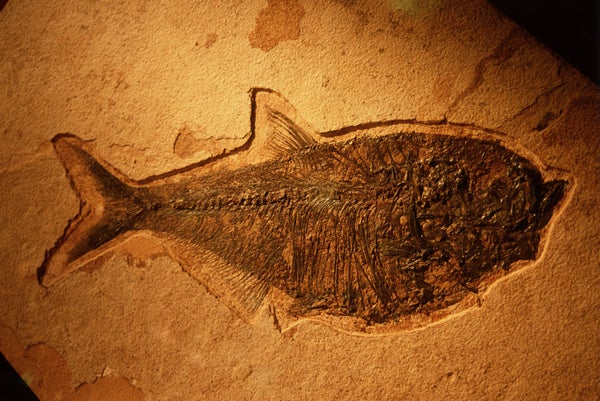

The fossil record is far from being a complete library of everything that's ever lived.
"The vast, vast majority of everything that's ever lived has completely decayed away, bones and all. So fossilization is a very rare occurrence." Duncan Murdock, a research fellow at the Oxford University Museum of Natural History.
"But then if you play the numbers game and think about how many organisms have lived, then fossilization is inevitable, that some things will get into the fossil record."
On supporting science journalism
If you're enjoying this article, consider supporting our award-winning journalism by subscribing. By purchasing a subscription you are helping to ensure the future of impactful stories about the discoveries and ideas shaping our world today.
But what parts of an organism fossilize—and in which stage of decomposition—can vary, meaning it can be hard to reconstruct a living animal from what's represented in rock. Plus, most of the fossil record is bones and teeth. To find any evidence of the soft-tissue of ancient animals is incredibly rare.
So, to learn more about the process of decay and fossilization that can preserve soft tissue, Murdock and his team dissect marine animals, like hagfish and lampreys, as they lie rotting in the lab. The study of how organisms become preserved is called taphonomy. And it can stink.
"Yeah, I mean it's certainly a very smelly place to work sometimes." Smelly, but it gives them a step-by-step look at how creatures' bodies change as they decay.
"The first signs the animal is decaying is the very softest tissues like the guts and eyes start to decay away, and then fine structures like the gills. And then things like the fins start to fall off, and you see the skin falling off. And then eventually all that you're left with are some little bits of cartilage, and remnants of the muscle blocks."
They break down their work in the journal Palaeontology—and make the case for why rotting flesh may give a fresh look at the fossil record [Mark A. Purnell et al., Experimental analysis of soft‐tissue fossilization: opening the black box]. Because what you don’t find—and the degraded state of the material you do find—have their own stories to tell about the history of life on Earth.
—Christopher Intagliata
[The above text is a transcript of this podcast.]
