
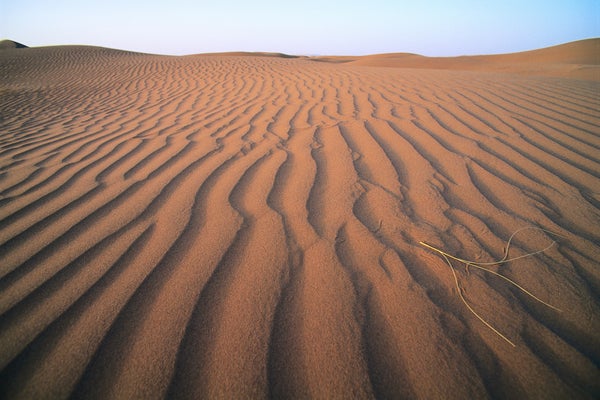

“The city of Tanis was consumed by the desert in a sandstorm which lasted a whole year. Wiped clean by the wrath of God.” Indiana Jones’s friend Marcus Brody, explaining the fictional fate of the city of Tanis in Raiders of the Lost Ark.
Back in real life, scientists have found something else covered by the Sahara’s sea of sand: an ancient river system. The remains of the main channel—which dried up long ago—wind beneath the west African desert for more than 300 miles before reaching the Atlantic Ocean.
Researchers led by Charlotte Skoniezcny of the University of Lille in France uncovered the system using a kind of satellite-borne radar that can penetrate through several feet of dry surface sediments like sand. The scientists think that the network may extend even farther inland, but thick dunes prevented them from mapping it. They report their findings in the journal Nature Communications. [Charlotte Skoniezcny et al, African humid periods triggered the reactivation of a large river system in Western Sahara]
On supporting science journalism
If you're enjoying this article, consider supporting our award-winning journalism by subscribing. By purchasing a subscription you are helping to ensure the future of impactful stories about the discoveries and ideas shaping our world today.
The discovery solves the mystery of what created a vast underwater canyon off the coast of Mauritania in northwest Africa. The subsurface ravine looks like those that form at the mouths of massive rivers today. But researchers had only hypothesized the existence of major waterways in West Africa until now.
The fact that rivers raged at the surface in this region sheds light on the Sahara’s tumultuous history. Scientists know that this vast desert wasn’t always dry. At certain times in the past, it boasted green grasslands teeming with life. The researchers think the Sahara’s lost river last flowed 6,500 years ago, revealing just how fast west Africa’s climate can change. Maybe not quite as fast as Indiana Jones swapping out a bag of sand for a golden idol. But still, surprisingly fast. “Wiped clean.”
—Julia Rosen
[The above text is a transcript of this podcast.]
[Scientific American is part of Nature Publishing Group.]
